

When Lush announced its collaboration with Download Festival (a limited-edition “revival kit” of body spray, soap and bath bomb), I ordered it immediately. I did not need it, nor did I plan to use it straight away; my purchase was prompted by the sense that this offering represented a rare alignment of brand strategy and subcultural identity. For a brief moment, the collaboration seemed to merge conscious consumption, festival ritual and community identity.
The set sold out rapidly. At first it appeared not only commercially effective, but conceptually coherent: Lush’s cruelty-free, vegan credentials appeared to sit neatly alongside the communal, intense, muddy world of the festival. Then the narrative changed. In June 2025, Download issued a public statement referencing the Equality and Human Rights Commission’s interim guidance on gender and toilets, effectively restricting trans people from using facilities aligned with their gender. According to PinkNews (2025), Lush terminated the partnership in response and reiterated its support for trans and non-binary communities.
What had begun as a model of ethical and aesthetic synergy rapidly became a cautionary example of how brand collaborations can unravel when moral values diverge.
What’s in the (Literal and Metaphorical) Box
The “Wash Pit” (see what they did there ;)) revival kit comprised three distinct items…
-
- Ace Of Sprays body spray (vegan) — fragrance notes: sandalwood, lavender, tarragon and spearmint.
-
- Circle Pit bath bomb — fragrance notes: juniperberry, tangerine, fennel and ylang-ylang.
-
- Download ‘25 soap — fragrance notes: charcoal, rose and basil.
These items operate on two levels. The logic was practical: no showers, sweaty tents, and the perpetual damp or dust of Donington mud. But symbolically, it worked on another level: naming the kit “Wash Pit” references the mosh pit, turning a site of chaos into one of renewal; the scent profiles evoke earth, wood, fire, ritual. Such translation is what cultural branding seeks.
As Holt (2004) explains, brands acquire cultural power when they become “vessels for identity myths,” resolving tensions between personal and collective values (p. 8). The Lush × Download collaboration enacted such a myth by offering a product-ritual that belonged in the muddy field yet carried a clean, ethical aesthetic.
Cultural Branding and the Politics of Authenticity
Holt (2004) and Banet-Weiser (2018) both situate branding within the negotiation of cultural meaning. Holt’s concept of cultural branding identifies brands as cultural mediators, while Banet-Weiser’s idea of brand activism positions them as moral actors. The Lush × Download collaboration initially achieved both: it resonated emotionally while performing a visible ethical stance.

This success, however, was contingent upon perceived value alignment. Banet-Weiser (2018, p. 23) warns that activist branding exists within capitalist systems that often reproduce the inequalities they claim to challenge. When Download’s trans-exclusionary policy became public, the collaboration’s moral coherence collapsed. Lush’s withdrawal preserved its credibility, but it also exposed the imbalance between brand ethics and festival governance.
From a sociological standpoint, this shift reflects Thornton’s (1995, p. 115) notion of subcultural capital — the symbolic legitimacy earned through authenticity. Download’s perceived betrayal of inclusivity eroded its cultural capital, while Lush’s decisive withdrawal safeguarded its standing as a brand aligned with progressive values.
Sustainability, Packaging, and the “Green Turn” in Metal Festivals
Lush’s collaboration also intersected with another defining feature of contemporary festivals: environmental marketing. The brand’s eco-friendly, plastic-free packaging and vegan formulations aligned neatly with Download’s growing sustainability agenda.
According to Download Festival’s Environmental Charter, the event has committed to waste reduction, renewable energy use, and sustainable travel partnerships (Download Festival, n.d.-c). Collaborations with Big Green Coach (which provides low-emission transport) and previously, Liquid Death (recyclable canned water) exemplify these initiatives. However, as Zifkos (2015, p. 8) argues, the “sustainable festival” movement often risks being more symbolic than transformative, functioning as a branding exercise rather than a structural intervention.
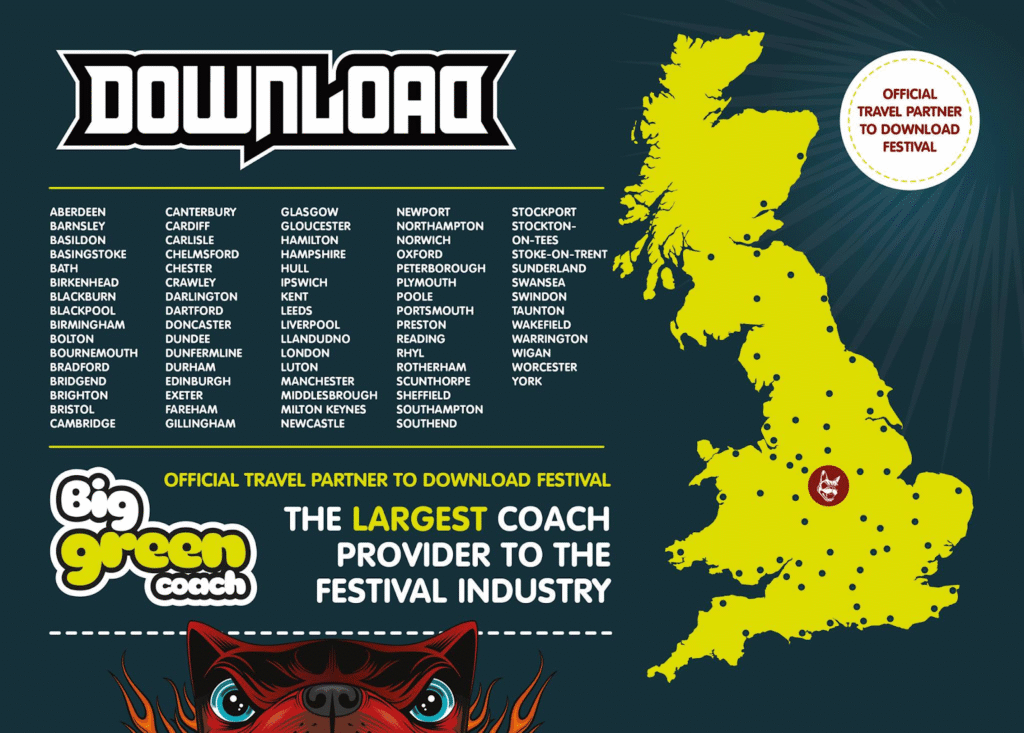
Kohlhofer et al. (2024, pp. 53-61) similarly highlight that sustainability in metal festivals frequently relies on perception rather than measurable outcomes. Audiences tend to reward festivals that visibly appear green, but without quantifiable evidence, such as reduced emissions or waste-diversion rates, these claims risk veering into greenwashing.
Lush’s participation initially lent Download credibility in this area, reinforcing the image of a socially conscious, eco-aware event. Yet the sustainability discourse within heavy music culture, as Kohlhofer et al. (2024, p. 59) demonstrate, is complex and relational. Audiences associate environmental responsibility with authenticity and moral integrity when it aligns with communal values, but they also express cynicism toward corporate narratives that lack transparency.
Séraphin (2018) adds that sustainability in festivals often functions more as a mechanism of social engagement than environmental impact. True sustainability, therefore, depends not just on messaging but on participatory practice. Download could enhance its credibility by publishing transparent impact reports, quantifying carbon reduction from Big Green Coach services, or incentivising sustainable behaviour onsite.
Zifkos’s (2015) critique remains pertinent: sustainability must be embedded into the festival’s ethos rather than marketed as an accessory. The Lush × Download collaboration succeeded in embodying that integration—until other forms of exclusion undermined the brand’s moral narrative.
Governance, Gender, and Safety
While Download’s environmental commitments have strengthened its public image, its governance controversies reveal deeper cultural tensions around safety and belonging. Gender remains a defining factor in how festival-goers experience these spaces. Riches (2011, p. 319) documents the barriers women face in heavy metal environments, from harassment to symbolic exclusion in mosh pits. Bows et al. (2023, p. 4) similarly note that women report significantly higher levels of concern regarding physical safety in crowded events.
Building on this, Rogers and Smith (2024) argue that gendered safety at festivals must be treated as a matter of governance rather than individual behaviour. Their research demonstrates that festivals relying on reactive security or “zero-tolerance” messaging fail to address the systemic causes of exclusion (pp. 6-7). Instead, they advocate for gender-sensitive governance models that integrate inclusivity into every layer of event management, from staff training to infrastructure design.
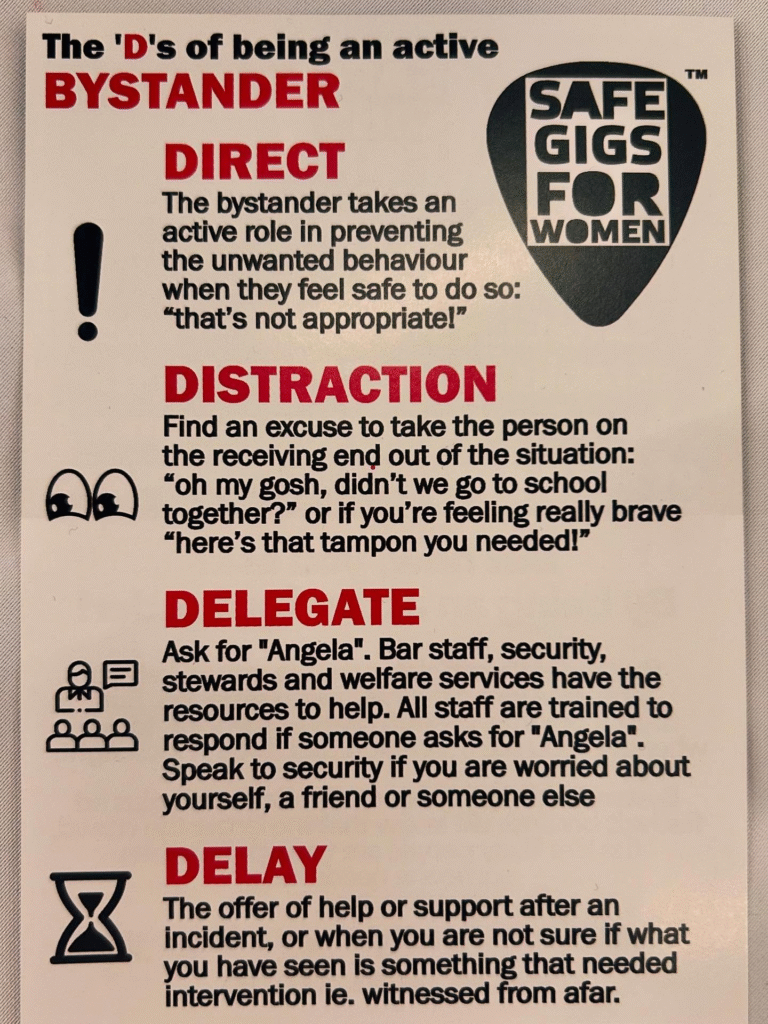
Crucially, Rogers and Smith highlight that trans and non-binary attendees experience what they term “compound vulnerability” (p. 10), facing not only the same risks of harassment as cisgender women but also the added threat of institutional exclusion. Many report avoiding toilets, camping areas, or security checkpoints due to fear of misgendering or confrontation. These exclusions, the authors argue, are not incidental but arise from festival governance structures that assume binary gender norms (pp. 10-11).
Within this framework, Download’s trans-exclusionary portaloo policy represents more than a PR misstep—it constitutes a governance failure that undermines both physical safety and psychological belonging. Rogers and Smith (2024, p. 12) conclude that true inclusion requires infrastructural adaptation (such as gender-neutral facilities), intersectional staff training, and explicit anti-discrimination protocols embedded in licensing and policy documentation.
For festivals that claim to champion community and inclusivity, safety cannot be divorced from identity politics. Implementing such measures would not only protect trans and non-binary festival-goers but also reinforce ethical alignment with partners like Lush, whose own brand activism centres on bodily autonomy, respect, and care.
Law, Policy, and Administrative Exclusion
From a governance and law perspective, Download’s statement represents a form of what Cooper (2019, p. 37) calls administrative exclusion: the use of procedural language to legitimate discriminatory outcomes. Within the festival’s temporary “microstate,” such decisions shape who feels entitled to occupy space.
Festivals are, as Bennett, Taylor, and Woodward (2014, p. 56) suggest, “temporary communities of affect,” defined not just by performance but by belonging. When governance undermines inclusion, the social contract of the event breaks down. Lush’s withdrawal became a counteraction: a symbolic restoration of ethical balance.
Conclusion: Moral Coherence and the Future of Festival Branding
The Lush × Download collaboration began as an exemplary instance of cultural and ethical alignment. It merged subcultural authenticity, sustainability, and sensory experience. Yet its collapse exposed the limits of that harmony. Ethical branding cannot survive in isolation from governance and inclusion.
Lush’s decision to end the partnership reaffirmed its brand activism while Download’s misstep demonstrated how quickly institutional credibility can erode. The collaboration remains instructive because it captured both what branding can achieve and what it cannot sustain.
As Kohlhofer et al. (2024, p. 62) argue, sustainable festival culture depends on “integrated sustainability,” where environmental, social, and cultural ethics coalesce. The Lush × Download episode illustrates what happens when that integration fails.
As both an avid Lush fan and heavy metal researcher, I experienced the Wash Pit kit as an intersection of theory and pleasure. The scents remain bold, but while using the products still feels good — it also feels different. What was once a gesture of uncomplicated fandom now carries reflection. The set has become a reminder that branding, however sensorial or sentimental, cannot be separated from the ethics of its context.
Banet-Weiser (2018, p. 142) writes about the “ambivalence of brand intimacy”—how emotional attachments to brands endure even as ideological alignment fractures. That describes my relationship with this set precisely: an affection that persists, tempered by critique. It’s still a symbol of recognition, but also of rupture.
References:
Banet-Weiser, S. (2018). Empowered: Popular feminism and popular misogyny. Duke University Press.
Bennett, A., Taylor, J., & Woodward, I. (2014). The festivalization of culture. Routledge.
Cooper, D. (2019). Feeling like a state: Desire, denial, and the recasting of authority. Duke University Press.
Bows, H., King, H., & Measham, F. (2023). Perceptions of safety and experiences of gender-based violence at UK music festivals. Journal of Gender-Based Violence, 7(1), 74-92. https://doi.org/10.1332/239868021×16439111624553
Download Festival. (n.d.-c). Environmental charter. Retrieved from https://downloadfestival.co.uk/sustainability/
Graff, S. (2022). A response to Woodstock 99: Peace, love, and rage; Recontextualizing editorial biases in nu metal. Comm-Entary, 18(1), 127-132. https://scholars.unh.edu/comm-entary/vol18/iss1/12/
Holt, D. B. (2004). How brands become icons: The principles of cultural branding. Harvard Business School Press.
Kohlhofer, S., Rautiainen, M., & Tschida, S. (2024). Metal meets green: A multifaceted exploration of sustainability perceptions at heavy metal music festivals. Journal of Event and Festival Studies, 12(1), 53-62. https://doi.org/10.11648/j.ijhtm.20240802.14
PinkNews. (2025, June 3). Lush “terminates Download Festival partnership” over trans toilet policy. https://www.thepinknews.com/2025/06/03/lush-download-festival-toilet-policy/
Riches, G. (2011). Embracing the chaos: Mosh pits, extreme metal music and liminality. Journal for Cultural Research, 15(3), 315-332. https://doi.org/10.1080/14797585.2011.594588
Rogers, H., & Smith, L. (2024). Gendered governance and inclusive safety frameworks in live music events: Toward equitable festival spaces. International Journal of Event and Festival Management, 15(3), 6-15. https://doi.org/10.1108/IJEFM-07-2024-0079
Seraphin, H. (2018). Sustainability and Festivals: An Objective Still to be Achieved. In H. Seraphin, & E. Nolan (Eds.), Green event and green tourism. An international guide to good practice.
Thornton, S. (1995). Club cultures: Music, media and subcultural capital. Polity Press.
Zifkos, G (2015) Sustainability Everywhere: Problematising the “Sustainable Festival” Phenomenon. Tourism Planning and Development, 12(1). 6-19. https://doi.org/10.1080/21568316.2014.960600