Act I: The March
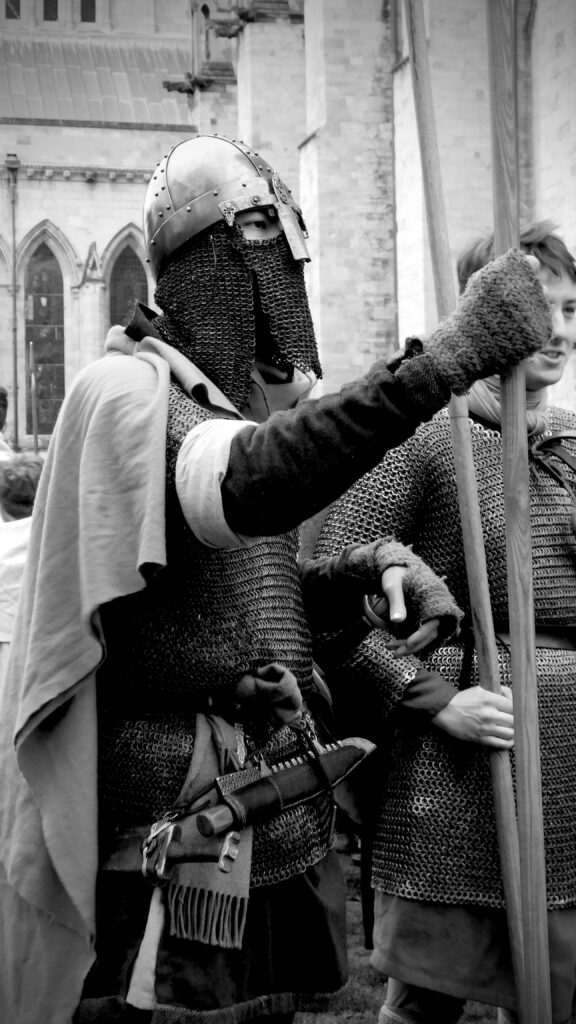
I finally made it to the Jorvik Viking march this year. Four years of living in York and somehow I’d always managed to miss it. Work, weather, other plans… There was always an excuse. So, when my day off lined up with the finale of the Festival it felt like I’d accidentally timed things pretty perfectly.
What struck me most wasn’t just the history, but the theatre of it all.
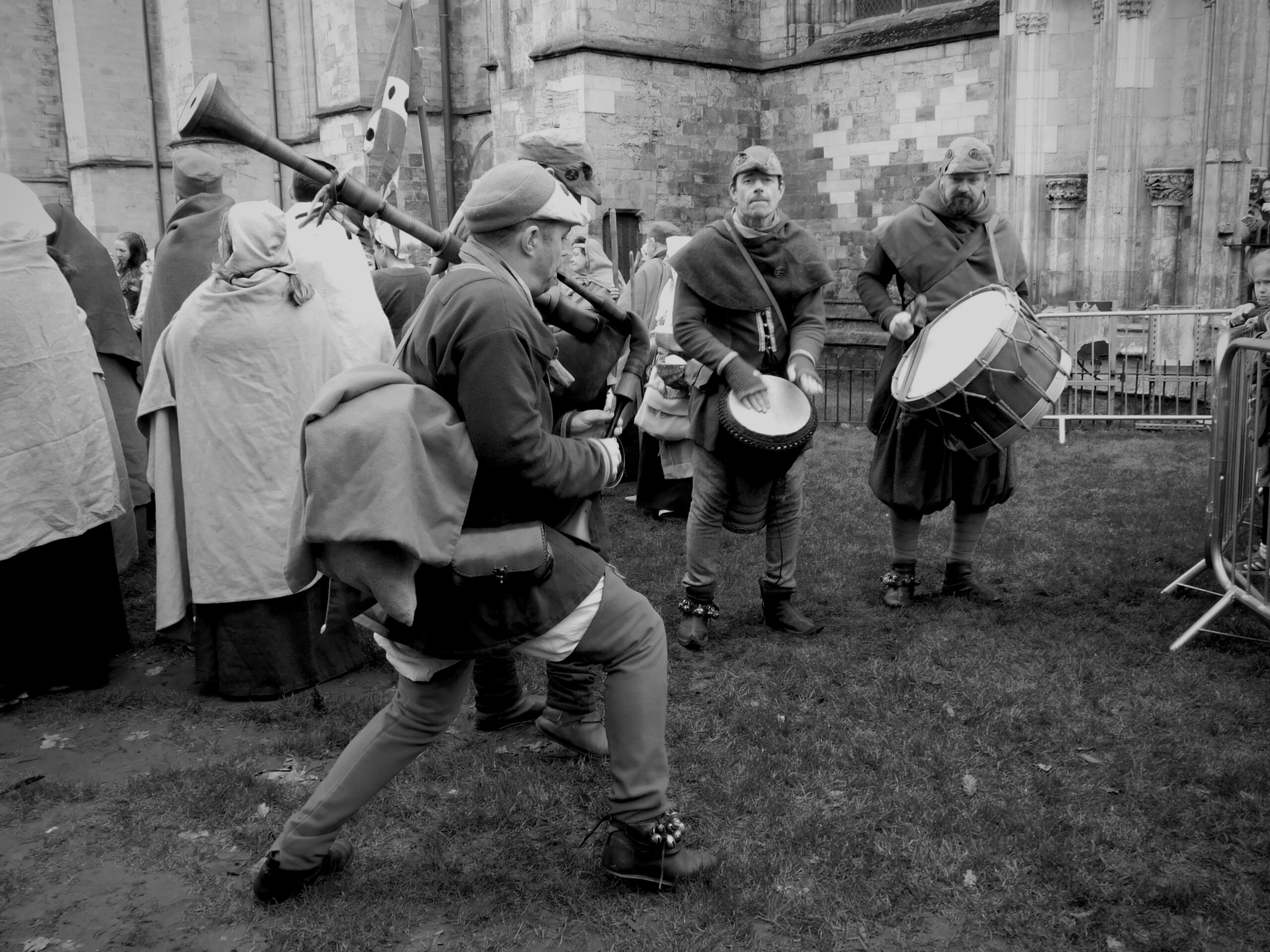
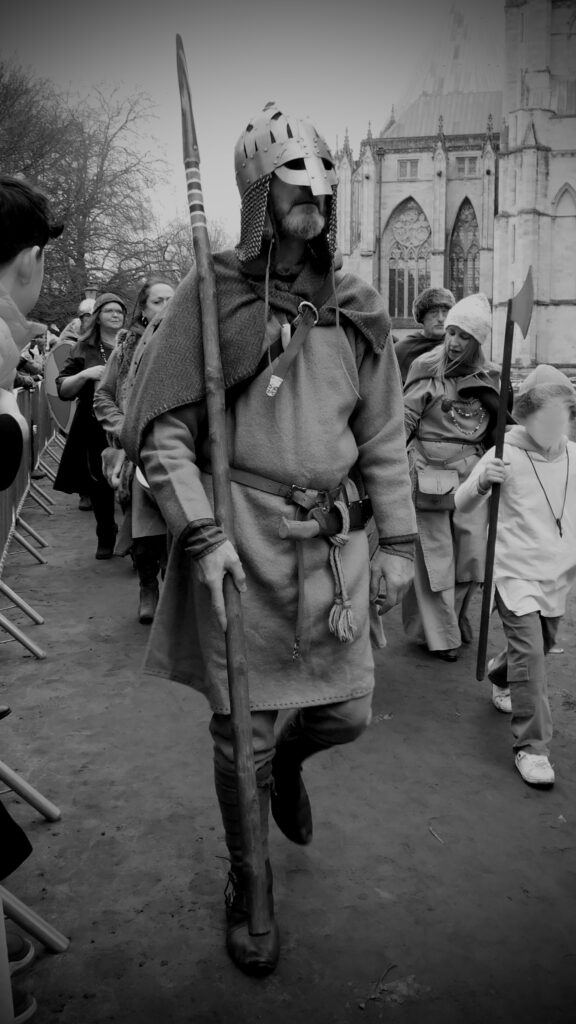
The march wound its way through the city with helmets catching what little sun there was, spears at the ready, and the steady thud of drums bouncing off buildings that have seen more than a few centuries themselves. It was unapologetically dramatic. The battle re-enactment near Clifford’s Tower leaned fully into spectacle: choreographed combat, shouted commands, the clash of metal on metal. It was immersive in the best way (beyond the walls of my beloved Dungeon of course…).
And in all honestly!? Viking history is perfect for that kind of theatricality.
Act II: Myth and Metal
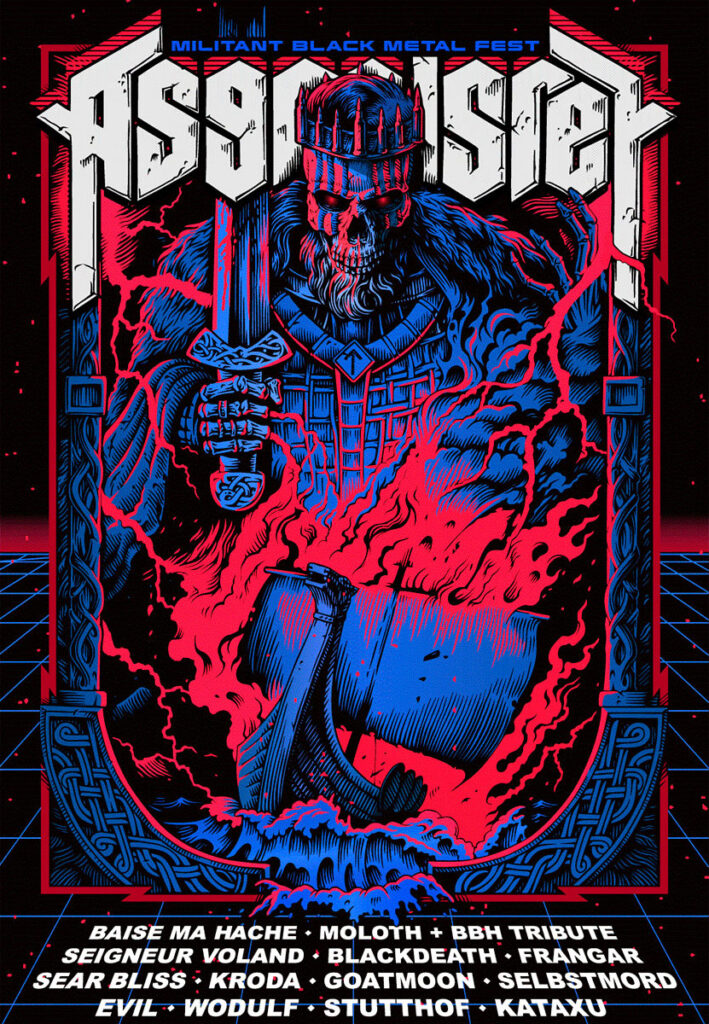
When you think about power metal in particular, it makes sense. Grand narratives. Mythic battles. Gods, fate, glory, apocalypse. There’s LOADS of research into the use of historic narratives in metal and why they work so well with a variety of audiences (La Rocca, 2017; Ashby & Schofield, 2015; Sellheim, 2018). The whole genre thrives on scale and ritual. There’s a reason so many bands lean into faux-medieval fonts, armour-adjacent stage wear, and quasi-mythological storytelling. The Viking march felt like stepping into an album cover (Amon Amarth I’m looking at you).
But what makes it work is that the theatricality doesn’t feel forced. Norse history and mythology are already ritualistic. Processions, oaths, sacrifices, cosmology, runes – they come pre-loaded with symbolic weight. Somehow when a group of musicians leads a mass of shield-carrying re-enactors through York’s streets, it doesn’t feel like an awkward grafting of performance onto the past. It feels like the re-imagining of a ritual.
That sense of ritual is something metal has always been good at tapping into. Extreme metal especially has a knack for creating atmosphere that borders on ceremonial: corpse paint, stage lighting and a sometimes uncomfortable sonic intensity. When you think of it like this, I honestly don’t see much of a difference between theatre kids and true kvlt elitists… but that’s a different debate for another day.
There’s a communal element there that goes beyond simply “watching a gig”. It’s participatory, immersive, embodied. Standing at the march, with the percussion reverberating through the crowd, I was reminded how naturally these aesthetics translate across contexts.
It also made me reflect, as I usually do, on how and why certain pasts get revived, stylised and circulated within alternative subcultures.
Act III: Aesthetics and Ideology
The “North” in metal has never been neutral. Scholars have long pointed out that “Nordicness” functions in multiple, sometimes contradictory ways within extreme metal scenes: as a brand of authenticity and extremity; as a marker of ethnic belonging; and as a symbol tied to contemporary liberal democratic identity (see Lucas, Deeks, & Spracklen, 2011). In other words, it’s not just about liking Vikings. It’s about what Vikings are made to mean.
On one level, Nordic imagery has become shorthand for authenticity and otherness. Since the rise of Norwegian black metal in the early 1990s, the region has been marketed – both internally and externally – as a bleak, frozen edge of Europe, geographically and culturally distant from commercial metal’s supposed centre (Kahn-Harris, 2007). “Nordic metal” becomes a trademark, a guarantee of extremity, isolation and sincerity. That branding still circulates today.
Used in this context, shields and runes aren’t just historical props; they’re aesthetic cues loaded with connotations of rawness, masculinity, pre-Christian “purity” and resistance to the mainstream. They look authentic. They feel ancient. They suggest roots.
The problem is that roots can be mobilised in different ways.
It’s no secret that strands of black metal have explicitly racialised those same symbols. The early Norwegian scene’s self-mythologising frequently invoked an imagined pagan past as a rejection of Christianity and modernity, but it also intersected with explicitly exclusionary and racist ideas (Fischer, 2022). National Socialist Black Metal (NSBM) represents the most overt example of this, framing “Nordicness” as synonymous with white, Aryan identity and treating Viking imagery as ancestral proof of ethnic belonging.
That’s where the discomfort creeps in for me…
Watching the march, I loved the spectacle. I loved the craft, the noise, the commitment. But I’m also aware that the same aesthetic vocabulary – runes, ravens, longships, the “heathen” North – has been reworked in ways that flatten complex histories into fantasies of homogenous whiteness. As Spraklen (2010) argues, “Nordicness” in metal can slide from a branded marker of extremity into a narrative of exclusory ethnic belonging. The Viking becomes less a historical figure and more a genetic inheritance.
At the same time, it’s important not to collapse everything into black metal, or to pretend nationalist themes are exclusive to its most extreme fringes. Beyond metal entirely, nationalist appropriations of Viking imagery have been visible in far-right movements across Europe and North America. The aesthetic has a portability that makes it easy to detach from historical nuance and reattach to modern political projects (Khan-Harris, 2007). That portability is precisely why it’s powerful.
Act IV: Reclaiming the Chorus
That isn’t the whole story…
The Nordic region also carries a contemporary reputation for liberal democracy, welfare infrastructure and cultural support – material conditions that have arguably enabled metal scenes to flourish in the first place (Kahn-Harris, 2007). There’s a tension there: between the imagined North of pagan liberty and the real North of social democracy. Between individualist anti-modern posturing and state-funded music education. Hoad and Whiting (2017) suggest that “Nordicness” in metal is fragmented, marked by paradox rather than purity. I find that framing useful.
There’s also something worth saying about power metal more broadly.
If black metal often approaches the past as rupture — through lenses of destruction, rejection, purification — some strands of power metal approach it through preservation. A lot of it just loves history. It doesn’t always handle it perfectly, and it certainly doesn’t handle it quietly, but there’s an obvious enthusiasm there. Battles, revolutions, last stands and lost kingdoms become tales amplified with double kicks and huge choruses.
And while that theatricality can absolutely romanticise conflict, it can also generate curiosity.
Bands like Eluveitie, Týr, Feuerschwanz and Gloryhammer have built entire careers on writing about historical battles and military events. You can debate their framing, their tone, their choices (and people often do!) but it’s difficult to deny that they’ve brought historical subjects to audiences who might never otherwise engage with them. More than that, they’ve actively used that platform in constructive ways. When a British Tank Museum was facing financial difficulty, Swedish power metal heavyweights Sabaton donated funds from merchandise sales to help keep it open. That’s not myth as exclusion, it’s history-as-stewardship.
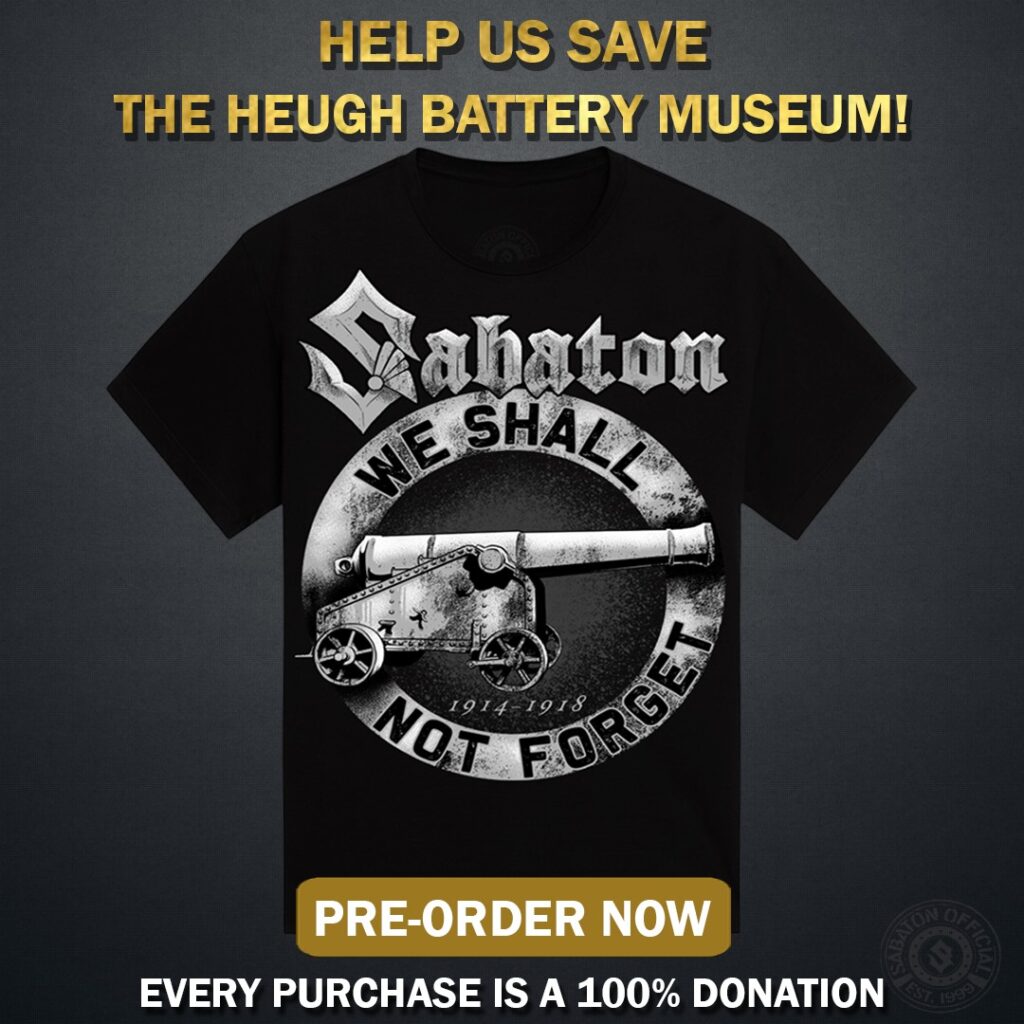
There’s something interesting there. I’m a big believer in using power for good, and while power metal might not be to everyone’s taste, I think instances like this should be recognised as a genuine effort to contribute to historic preservation, especially in such a publicly accessible form.
Power metal’s relationship to the past isn’t usually framed around ethnic belonging in the same way as some strands of extreme metal, and is often international. One album might move from Sweden to Poland to the Pacific. The past becomes shared human drama rather than ancestral proof. It’s still theatrical, but it isn’t always insular.
I think a lot of power metal musicians recognise the responsibility that comes with handling history. They’re aware that they’re shaping perception. When that influence is directed toward education, preservation, or genuine commemoration rather than mythic purity, it shifts the tone entirely.
Which brings me back to York.
Encore: History Done Well
Standing there, watching a staged Viking battle unfold in front of Clifford’s Tower, I was reminded that history is never just content. It’s a resource. It can be mobilised for spectacle, for ideology, for branding, for education, for community. The difference lies in intent — and in the conversations we’re willing to have around it.
Metal, for all its noise and distortion, has always been a genre that takes the past seriously. Sometimes too seriously. Sometimes not seriously enough. But when it leans into theatricality with awareness — treating history as something to explore rather than weaponise — it can create something powerful, communal, and even constructive.
And that’s the version of ritual I’m most interested in.
Not purity. But shared, hands-on engagement with the past.
What I saw in York this week certainly wasn’t a political rally. It was families, tourists, locals, re-enactors and students – people enjoying a shared, theatrical engagement with times gone by. It was history as performance, not as manifesto. The past, temporarily animated for communal enjoyment (and a bit of extra tourist income for the city if I’m feeling cynical).
That didn’t mean the symbols were empty though.
For me, that’s part of why events like this matter. They’re a reminder that history doesn’t sit still. It is constantly reinterpreted, commercialised, reclaimed and resisted. The same shield can be a museum replica, a stage prop, an album cover centrepiece or a hate symbol, depending on who’s holding it and what story they’re telling.
Metal has been drawn to the dramatic since its inception. Viking history offers it a ready-made archive of gods, battles and apocalyptic horizons. It fulfils a need for ritual and spectacle in a way that feels almost intuitive. But as fans, scholars, or just observers, we also have to be wary of how those aesthetics travel – and what they’re made to signify along the way.
I think there’s definitely more to think and talk about when it comes to Vikings and Paganism in metal, and I’d be lying if I said living in York wasn’t the perfect springboard for this. Perhaps a little later down the line I’ll come back to this subject, but for now it goes without saying…
ᛋᚳᚱᛁᚠᚪ ᚾᚩᚳᚢᛏ!
References:
Ashby, S., & Schofield, J. (2015). Hold the heathen hammer high: Representation, re-enactment and the construction of Pagan heritage. International Journal of Heritage Studies, 21(5), 1-16. https://doi.org/10.1080/13527258.2014.960441
Fischer, J. (2022). Pagan Metal Gods: The Use of Mythology and White Supremacy National Socialist Black Metal. react/review: a responsive journal for art & architecture, 2. http://dx.doi.org/10.5070/R52056635
Hoad, C., & Whiting, S. (2017). True Kvlt? The Cultural Capital of “Nordicness” in Extreme Metal. M/C Journal, 20(6). https://doi.org/10.5204/mcj.1319
Kahn-Harris, K. (2007). Extreme Metal: Music and Culture on the Edge. Oxford: Berg.
La Rocca, F. (2017). The Viking raids of England in metal music: From ideology to parody. Metal Music Studies, 3(2), 219-229. https://link.gale.com/apps/doc/A497099158/AONE?u=anon~4b6c382e&sid=googleScholar&xid=9c7e2dc6
Sellheim, N. P. (2018). ‘The rage of the Northmen’: Extreme metal and North-motivated violence. Polar Record, 54(5-6), 339-348. Https://doi.org/10.1017/S0032247419000020
Spracklen, K. (2010). True Aryan black metal: The meaning of leisure, belonging and the construction of whiteness in black metal music. In N. Scott & I. von Helden (Eds.), The metal void: First gatherings (pp. 81–93). Oxford: Inter-Disciplinary Press.