Exploring how Iron Maiden’s The Number of the Beast shapes the portrayal of Satan in 28 Years Later: Bone Temple, and why the real “devil” in the film isn’t who you think.
Today (22/3/2026) marks 44 years since Iron Maiden’s Number of The Beast was released, and what a 44 years that song has had… Racking a humble 300,000,000 streams on Spotify alone it’s arguably one of the band’s most iconic tracks, and for people like me, perhaps an early encounter with the NWOBHM. From beginning to end I don’t think there’s any choice but to pay close attention; from Barry Clayton’s chilling recital of Revelations to Bruce Dickinson’s soaring vocals tied in with super satisfying riffs it’s nothing short of a banger. This also makes it easy to see why the song has cemented its place not only in the history of metal music, but broader popular culture too. From Sherlock to South Park, Number of The Beast, much like the band itself, has been pretty much everywhere… It’s most recent appearance came in Nia DaCosta’s 28 Years Later: Bone Temple, the fifth instalment of Danny Boyle’s post-apocalyptic franchise.
Let me tell thee, I was in the cinema literally kicking my feet with excitement when the scene came around, and I was not disappointed. I think the franchise itself offers a huge amount of food for thought, but Number of The Beast’s anniversary seemed like cause for celebration… and what better form of celebration than a blog post(!?)
What I wasn’t expecting, though, was how effectively the film uses that song — not just as a reference, but as a way of asking a much darker question. Last week, I wrote a bit about why Satan still appears in day to day life, this time, I’ll be using a ficitional case study to explore:
What happens when we forget what the Devil actually looks like?
A Pastoral Apocalypse (With Free Spine Removal!)
I didn’t feel as though 28 Years Later (the prequel to Bone Temple… stick with me here I promise it’s important) was particularly interested in replicating the frantic, urban horror that defined 28 Days Later. Instead, it leans into something slower and, in its own way, more unsettling. We briefly return to 2002 to show the moment just before societal collapse, grounding the narrative in a domestic setting that feels recognisable and stable. That stability does not last long. The intrusion of violence is abrupt, and in all honesty genuinely terrifying — especially for those close to myself in age who might recognise elements of their own childhood in the seconds of peace prior. Once the infection arrives, there is no sense that it can be contained.
By 2030, what remains of the United Kingdom is fragmented into isolated communities that have adapted by abandoning modernity rather than attempting to rebuild it. The settlement on Lindisfarne, a real tidal island with historical ties to early medieval Christianity just off the North East, offers a particularly clear example of this shift. Life here is agrarian and tightly controlled, structured around farming, defence, and survival. Movement is limited, resources are managed carefully, and social roles are clearly defined.
There is a certain calm to it, at least on the surface. The film leans into imagery of rural England and medieval pageantry, creating a version of the apocalypse that feels almost peaceful. It is, briefly, quite convincing.
Then someone gets their spine removed…
Peace, as it turns out, is relative.
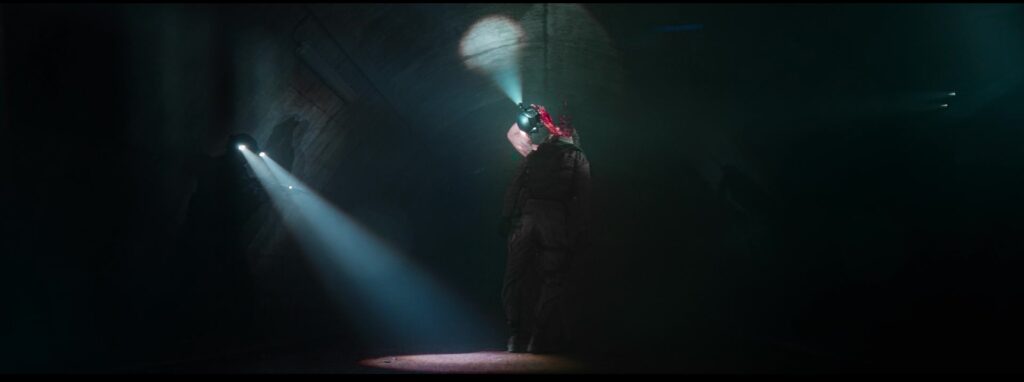
The Bone Temple
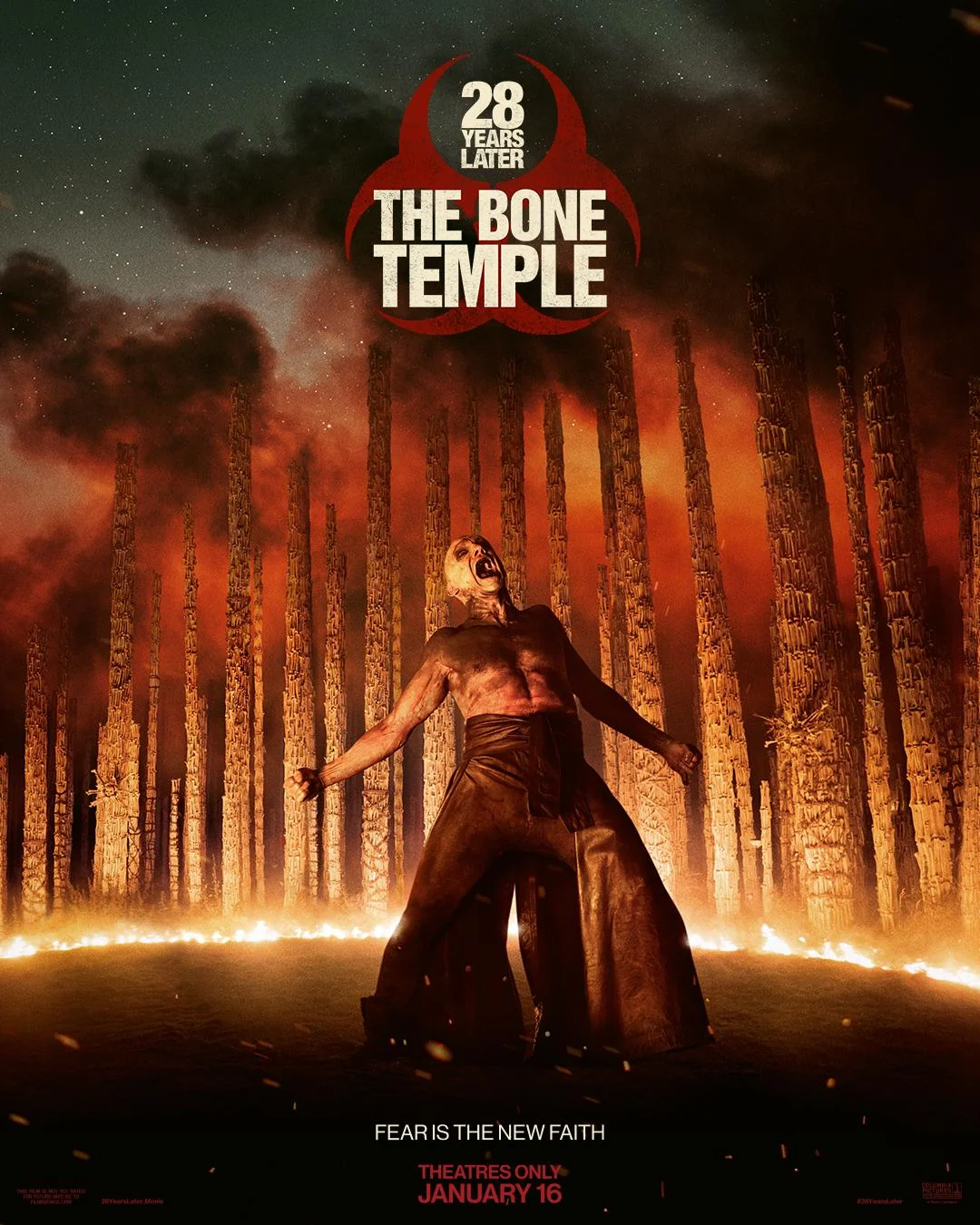
Okay, preamble done and on to the main event. Bone Temple follows on directly from the end of 28 Years Later, making for a very solid double bill if you ever have an evening free. At the centre of the film’s visual language sits the Bone Temple, a structure constructed entirely from human remains and arranged in a way that immediately recalls ossuaries like the Paris Catacombs and Santa Maria della Concezione Crypts in Rome. Historically, these spaces have functioned as sites of remembrance, integrating death into a broader religious framework that offers some sense of continuity or meaning — super interesting stuff, and you cand find out more about them here. In Bone Temple, however, that framework is notably absent.
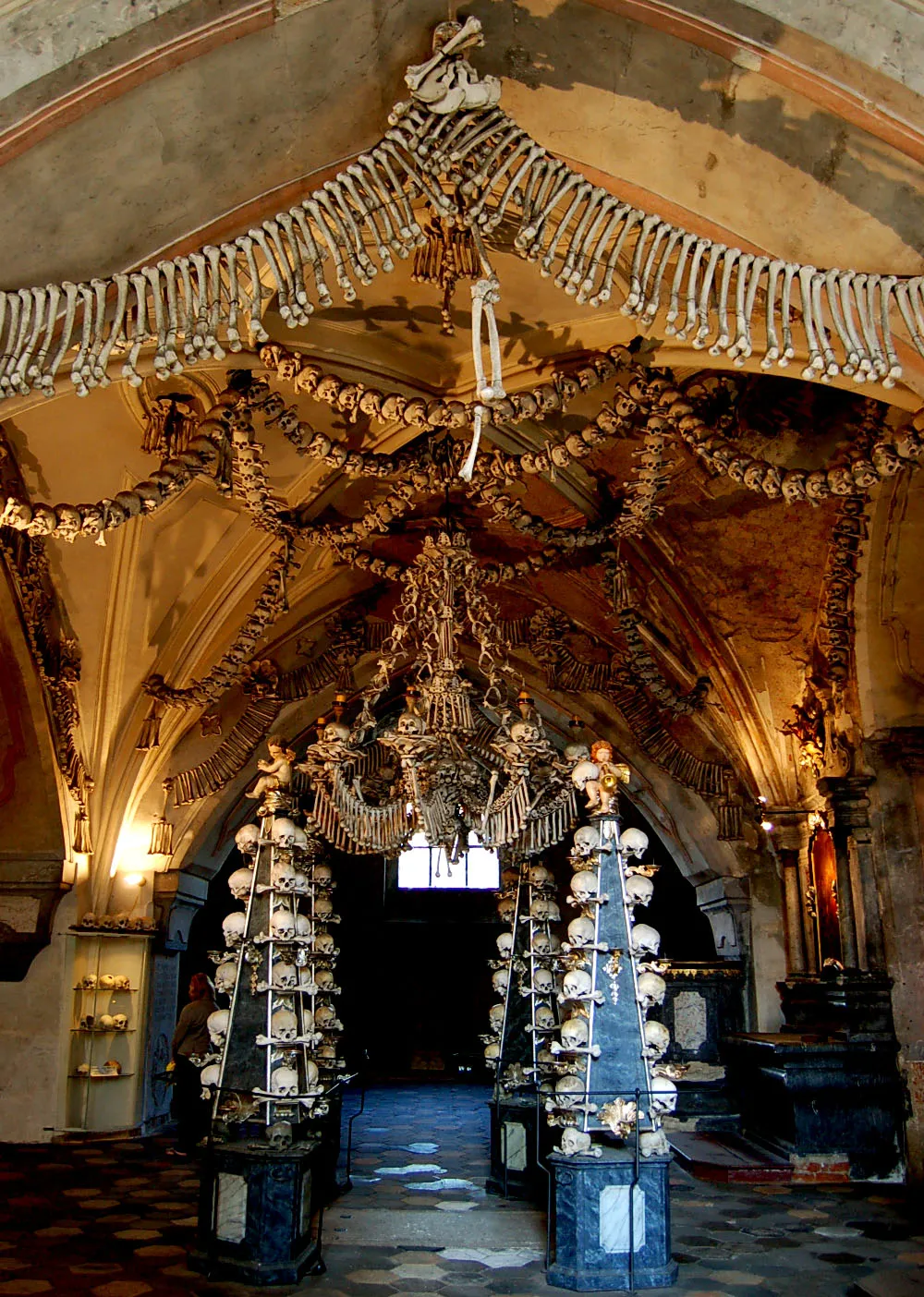
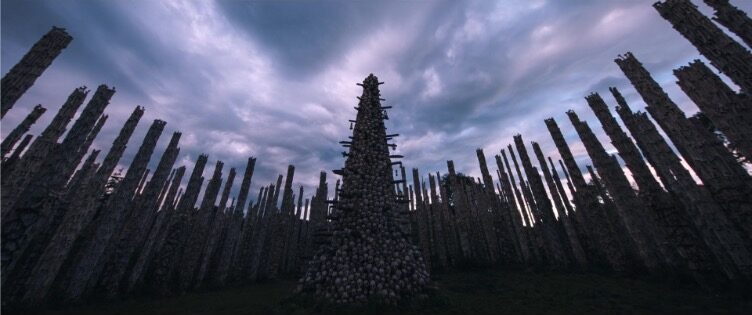
(L) Sedlec Ossuary “Bone Church” A church of bones, decorated with 40,000 human skeletons, Kutna Hora, Czechia. (R) The Bone Temple
The structure is undeniably ritualistic, and the film’s stunning visual storytelling abilities really shine through this particular set, but it does not point toward any clear system of belief. There is no suggestion of divine presence or transcendence, only the careful arrangement of bones into something that resembles a sacred space. What remains is form without doctrine, ritual without theology, and meaning that has been stripped back to its most basic components.
It feels important. It looks intentional. It is also, if you hadn’t yet noticed, built out of skulls.
Which tends to complicate things.
The Temple operates as an inversion of traditional religious architecture, transforming death into something that can be organised and, to a certain extent, aestheticised. In doing so, it also aligns with long-standing cultural associations between Satan and the reversal of established moral or spiritual orders. However, the film resists presenting this space as explicitly Satanic in a conventional sense. Instead, it uses the imagery to create a framework within which the idea of the Devil can be explored and exploited without ever being fully defined.
The Devil We Recognise
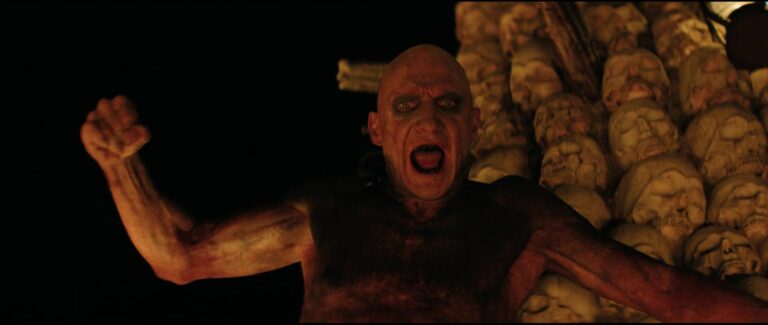
This ambiguity becomes more pronounced through the character of Dr. Kelson, played impeccably by Ralph Fiennes. Kelson is visually positioned in a way that strongly aligns him with the Bone Temple and the symbolic weight it carries. His environment, his presentation, and the way he is framed within the film all contribute to an immediate association with something infernal, or at the very least, a bit unhinged.
If you were asked to identify the Devil in this particular world, he might be the obvious candidate to some. The issue is that he does not necessarily always behave like one.
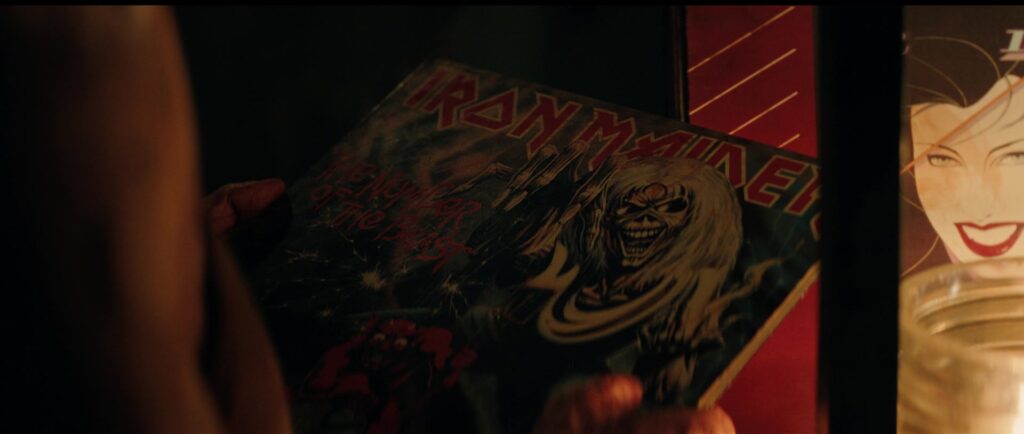
Despite his bright red iodine-stained skin, seeming ability to reason with the unreasonable, and most importantly — affection for one certain British heavy metal band; Kelson is rational, controlled, and, in many respects, one of the few characters who appears to operate according to a consistent internal logic. His actions are unsettling, but they are not arbitrary. They are deliberate, and they suggest an attempt to impose some form of order on a world that has lost any clear structure.
What makes this particularly interesting is that Kelson seems to understand the role he is playing. His alignment with Satanic imagery is not accidental, nor is it presented as a genuine expression of belief. Instead, it functions as a rather tasty piece of performance art, a way of inhabiting a symbol that still carries meaning even in a world where its original context has disappeared. Kelson’s role is simple: become the Devil to expose true evil.
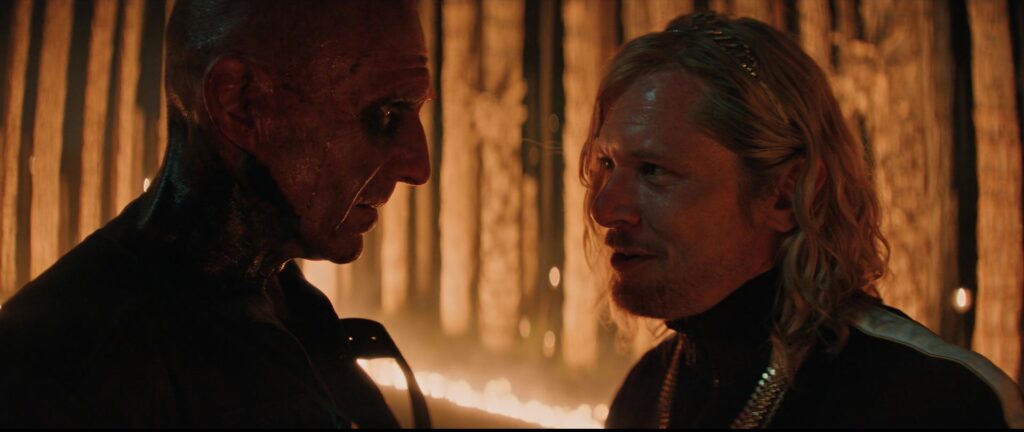
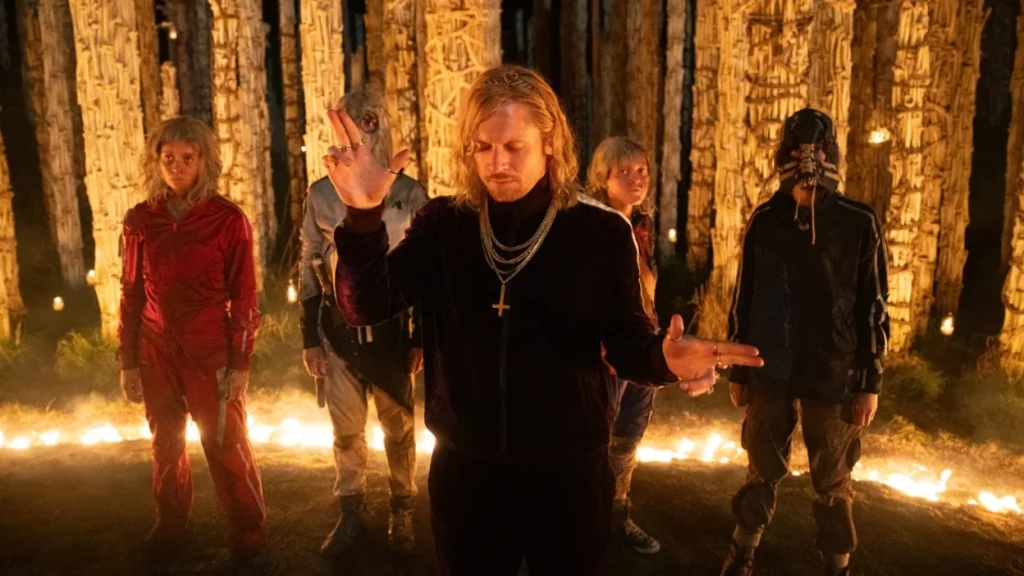
It is in the film’s use of The Number of the Beast that this idea reaches its clearest expression. The performance scene is not just a stylistic flourish or a well-placed needle drop for those of us who get a bit too excited in cinema seats; it is a carefully constructed moment in which sound, image, and symbolism converge. As Kelson delivers the track — or more accurately, embodies it — the sequence leans heavily into the theatricality that has always defined Iron Maiden’s work. The cadence of the spoken-word introduction, originally performed by Yorshireman Barry Clayton (although rumour has it horror icon Vincent Price was the first choice, had it not been for a £25,000 budget constraint), becomes less a quotation and more an invocation, repurposed within a world that no longer remembers the scripture it came from but still recognises its tone.
Visually, the scene does a significant amount of work to reinforce this ambiguity. Kelson is framed not simply as a performer, but as a figure occupying a liminal space between ritual and spectacle. The Bone Temple itself becomes a stage, its architecture transforming from a site of death into something resembling a cathedral of performance. Firelight, shadow, and the stark geometry of bone structures all contribute to an image that feels unmistakably “Satanic” in the cultural sense, even though there is no explicit claim to theology or belief. It is, quite literally, the Devil as we have been taught to recognise him — red, ritualistic, commanding attention.
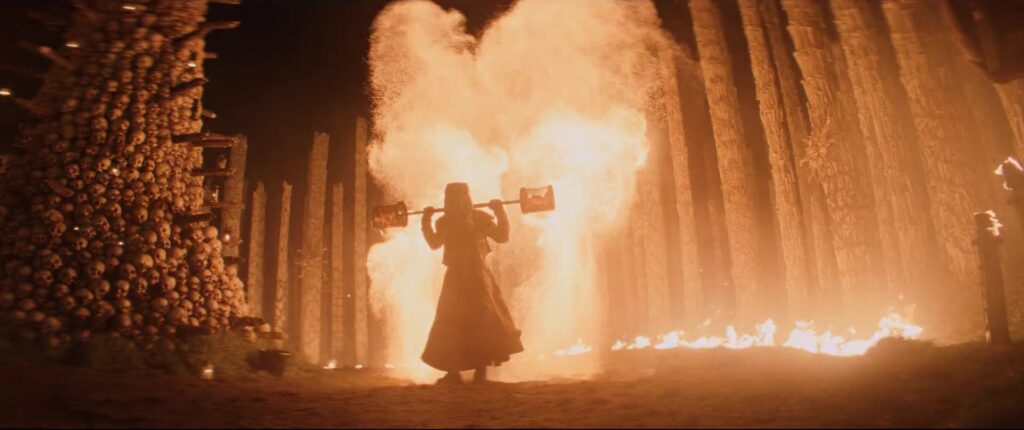
And yet, the tone of the scene resists full commitment to that reading. There is an awareness running through it, a sense that Kelson is not lost in the role but actively sustaining it. His delivery lacks the chaos or fanaticism one might expect from someone genuinely consumed by the imagery he evokes. Instead, it is measured, almost controlled, as though he is carefully calibrating the performance to achieve a specific effect on those watching. The result is something that sits uncomfortably between sincerity and strategy, forcing the audience to question whether what they are witnessing is an act of belief or an act of demonstration. This reaches its climax when Kelson carries out the inverted crucifixion of Jimmy, mirroring the inverted pectoral cross given to him by his father 28 years earlier. Kelson’s final act leaves us as viewers wondering if perhaps he wasn’t as passive as we’d like to believe, but whether that passivity was ever the point to begin with.
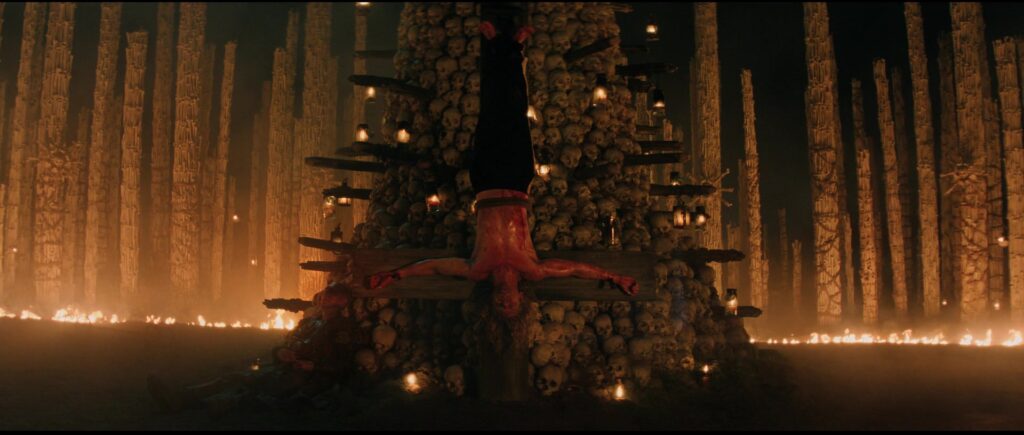
Because in that moment, the performance collapses into action. The symbolism is no longer contained within the safety of spectacle; it is enacted, imposed, made materially real. The inverted crucifixion is not subtle, nor is it particularly interested in being misunderstood. It draws directly on a visual language that has, for decades, been associated with Satanic inversion, anti-Christian imagery, and moral transgression. It is, quite literally, the kind of act we have been trained to read as “devilish.” And yet, placed within the context of the film, it refuses to settle into that interpretation quite so easily.
What complicates the scene is not the act itself, but who is performing it, and why. Kelson does not appear to take pleasure in it, nor does he frame it as punishment in any conventional sense. Instead, it reads as a deliberate gesture, one that is designed to communicate something beyond the immediate violence it entails. In mirroring the inverted cross imposed on Jimmy in his childhood, Kelson creates a visual and narrative loop that ties past and present together, suggesting that what we are witnessing is not simply an isolated act, but the culmination of a longer trajectory of influence, belief, and misrecognition.
This is where the discomfort really begins to set in. Because while the imagery is overtly Satanic, the intention behind it does not align neatly with that label. Kelson is not enacting chaos for its own sake, nor is he embodying evil in a way that is self-serving or indulgent. If anything, the scene suggests a form of grim pragmatism, a willingness to utilise the language of evil in order to expose or confront something he perceives as worse. It is here that the boundaries between performance and belief, symbol and action, begin to blur in a way that the film never fully resolves.
And crucially, Jimmy still does not recognise it.
Even in the face of such explicit imagery, there is no clear indication that Jimmy understands the role he has occupied within the film’s moral framework. The inversion, the ritual, the spectacle — all of it points toward a version of the Devil that he has been conditioned to recognise, and yet he remains, in many ways, outside of that understanding. This is what makes the scene so effective. It is not simply about punishment or retribution, but about the failure of recognition that has defined his character from the beginning.
The Devil We Miss
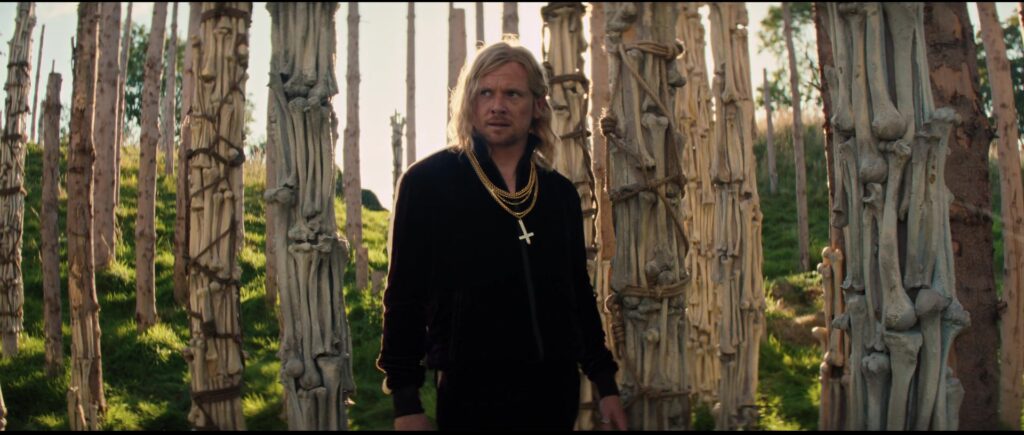
If Kelson represents the Devil as he is traditionally imagined, Jimmy Crystal represents something far more uncomfortable. It has to be said that Jack O’Connell absolutely smashed this role, I’m so glad to see him becoming a real powerhouse of the horror/thriller scene. Unlike Kelson, Jimmy is not framed through overtly symbolic imagery, nor is he associated with spaces that immediately signal danger or transgression. His presence is comparatively unremarkable, which makes the gradual realisation of what he represents all the more unsettling.
Jimmy embodies the erosion of moral boundaries in a world where survival has become the primary organising principle. His actions are not presented as extraordinary within the context of the film; they are consistent with the conditions that have emerged in the aftermath of societal collapse. Violence is normalised, exploitation is unremarkable, and ethical considerations are secondary at best.
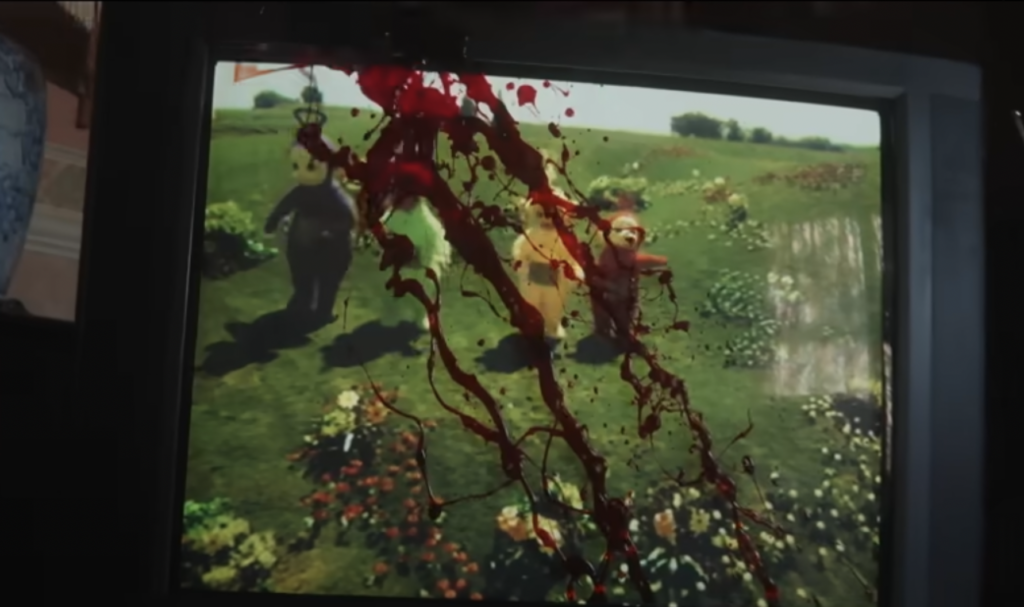
And yet, he is not identified as the Devil because he does not look like one. We first meet Jimmy in the opening scene of 28 Years Later, the very same boy we see having all memory of The Teletubbies absolutely decimated (which admittedly has to suck), we follow him to a small church, where he seeks comfort and sanctuary in his Father, the Parish Priest. His Dad, it seems, has lost the plot — and more strikingly his faith. When you put the pieces given to you by both films into the same puzzle, Jimmy’s reverence toward the Devil becomes a little easier to understand. In the absence of a God who could save his family during the initial infection outbreak, perhaps the existence of a Devil who chose not to becomes more feasible.
This is where the film’s use of Satanic imagery becomes particularly effective. By maintaining a clear visual language for what the Devil is supposed to look like, it creates the conditions for that image to be misapplied. Kelson fits the template, so he is treated as the threat. Jimmy does not, so he is overlooked by his younger, more impressionable followers: the Jimmies. It is not subtle. It is, however, very effective.
Jimmy Savile and the Problem of Recognition
Jimmy Crystal’s idolisation of Jimmy Savile adds an additional layer to this misrecognition. In the world of Bone Temple, Savile’s crimes were never exposed, and his public image remains intact. Without access to the information that would reframe him as a figure of harm, he continues to exist as a cultural icon, admired rather than condemned.
This detail is both historically grounded and deeply uncomfortable. Savile’s real-world legacy is defined by the extent to which his public persona allowed him to evade scrutiny, highlighting the gap that can exist between image and reality. In the context of the film, this gap becomes even more pronounced, as the collapse of institutional structures removes the mechanisms through which such truths might be revealed or acknowledged.
Jimmy’s admiration for Savile therefore mirrors his own position within the narrative. He idolises a figure whose evil was concealed, while simultaneously existing within a moral framework that prevents him from recognising similar patterns in his own behaviour. The result is a feedback loop in which harmful actions are normalised and perpetuated without reflection.
The Number That Stuck
The reference to The Number of the Beast sits neatly within this broader discussion of recognition and misrecognition. When the track was released in 1982, its use of biblical imagery and the number 666 contributed to its notoriety, particularly in the context of wider anxieties about Satanic influence in popular culture. Over time, however, that imagery has been absorbed into mainstream cultural language, losing much of its original capacity to shock.
It is worth noting that 666 was not the only number historically associated with the Beast. Early manuscript variations of the Book of Revelation like Papyrus 115 include 616 (ἑξακόσιοι δέκα ἕξ), suggesting that the number itself was subject to interpretation and change. The eventual dominance of 666 can be attributed, at least in part, to its visual symmetry and ease of recognition, qualities that make it particularly effective within systems of cultural reproduction.

In other words, it stuck.
Not because it was definitively correct, but because it was memorable, repeatable, and easy to deploy across different contexts. The same logic applies to the broader visual language of Satan that has developed over time. Certain images and associations persist because they are effective, even if they no longer accurately reflect the realities they are used to describe.
Getting the Devil Wrong
What 28 Years Later: Bone Temple ultimately demonstrates is that the persistence of these symbols can become a problem as much as an asset. While they provide a way of organising perception, they also create the conditions for misinterpretation. When the Devil is expected to look a certain way, anything that does not conform to that expectation risks being overlooked.
Kelson is identified as the Devil because he fits the image. Jimmy is not, because he does not.
The implication is not particularly comforting.
It suggests that our ability to recognise harm is, to a significant extent, shaped by the cultural frameworks we inherit, and that those frameworks are not always reliable. Symbols persist, but their meanings shift, and the gap between the two can have real consequences.
After the End
The 44th anniversary of The Number of the Beast provides a useful moment to reflect on how Satanic imagery has been constructed, circulated, and ultimately normalised over time. Iron Maiden’s role in shaping that imagery is undeniable, as the band helped to refine a version of the Devil that could be easily recognised and reproduced across different media. However, as 28 Years Later: Bone Temple makes clear, the success of that imagery also introduces a degree of risk, particularly when it becomes detached from the contexts that originally gave it meaning.
That tension is something the band themselves seem acutely aware of, especially in relation to the film’s use of The Number of the Beast. Speaking about the placement, they noted that
That sense of surprise is telling, not just because of the scale of the scene itself, but because of how effectively the film recontextualises the track. What began as a piece rooted in biblical imagery and heavy metal theatrics is transformed into something far more ambiguous, operating within a narrative that actively questions the reliability of those very symbols.
The band also emphasised
That phrasing feels particularly appropriate here. A calculated risk implies an awareness that meaning is not fixed, that once a piece of music enters a new context it can take on interpretations that extend beyond its original intent. In Bone Temple, that risk pays off precisely because the film does not simply use the song as aesthetic reinforcement, but as a tool to interrogate how and why certain images of evil persist.
There is also, perhaps, a degree of irony in the band’s closing remark that
On one level, it reflects the continued relevance of their work within contemporary media. On another, it highlights the extent to which their imagery has become embedded within a broader cultural framework that now operates independently of the band itself. The Devil they helped popularise no longer belongs solely to them; it circulates freely, appearing wherever it is needed, often stripped of its original context but still instantly recognisable.
When symbols become detached from those contexts, they do not disappear. They continue to function, but in ways that may not align with the realities they are meant to represent. The Devil persists, but he does so as a cultural construct that is subject to reinterpretation, misapplication, and, at times, complete misunderstanding. What 28 Years Later: Bone Temple demonstrates with uncomfortable clarity is that this persistence can distort as much as it reveals, particularly in a world where the mechanisms for understanding and verifying meaning have broken down.
Which brings us back to the film itself. In a world where civilisation has collapsed, knowledge is fragmented, and survival takes precedence over everything else, the Devil has not vanished. He has simply become harder to recognise. The imagery remains intact, the references still circulate, and the symbols continue to carry weight, but their connection to reality has weakened to the point where they can no longer be relied upon as accurate indicators of harm.
And unfortunately, he is not the one who built the Bone Temple.
Keep Reading...