How The Satanic Temple’s Baphomet challenge exposed constitutional limits on religious monuments in public spaces
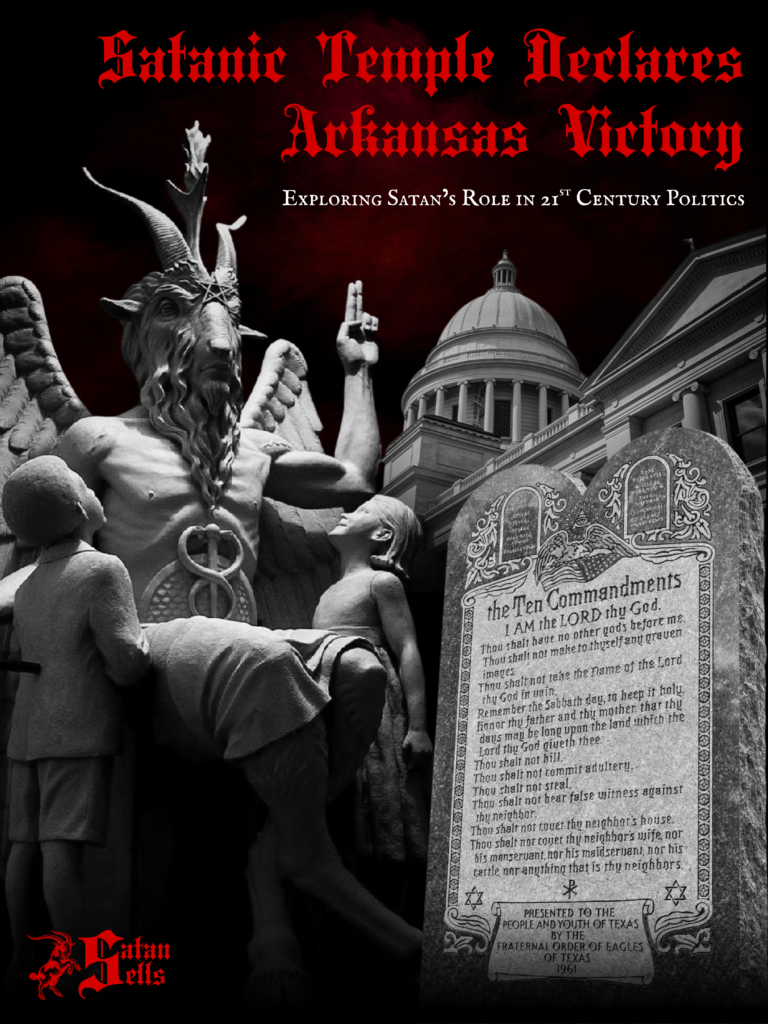
The Satanic Temple (TST) seem to be having particularly busy times as of late. Not to be confused with the preceding Church of Satan (1966), TST operates less like a traditional religious organisation and more like a legal pressure point… One that has become very good at inserting itself into situations where the state would rather not be asked too many follow-up questions.
Before going any further, I do think it’s worth mentioning something that can sometimes get lost in the more theatrical framing of all of this: TST are not without flaws. Even among those broadly sympathetic to church–state separation, they are sometimes viewed as deliberately provocative to the point of performance. Their use of Satanic imagery (in this instance Baphomet, inverted symbolism, theatrical protest) is designed to unsettle, and it works. Critics argue that this risks trivialising legitimate constitutional concerns, or at the very least reframing them in a way that makes serious engagement more difficult. Questions have also been raised about whether TST functions more as a strategic activist organisation than a sincerely held religious movement. None of that necessarily undermines their legal arguments, but it does complicate the way they are received.
I think this is part of the whole point.
The moment a government chooses to place a religious monument on public land, it creates a problem for itself. Not immediately, and not always obviously, but inevitably. Put simply, it becomes a question of consistency. Arkansas, as it turns out, gave us a particularly clear answer to this dilemma…
The monument in question, was, on its face quite simple.
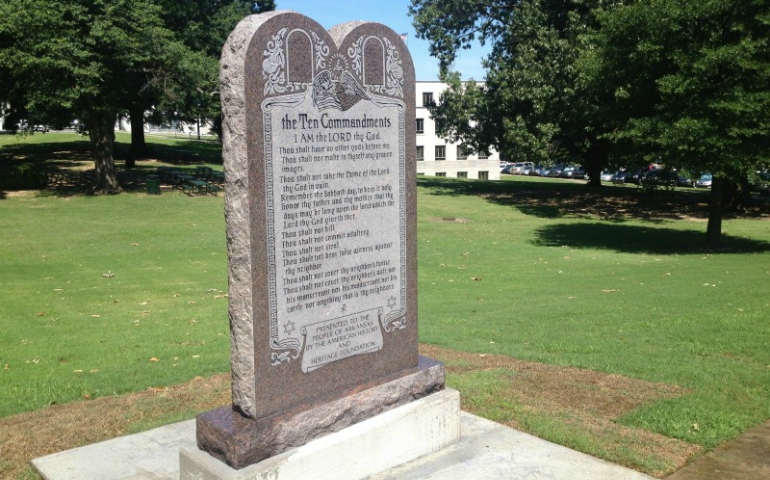
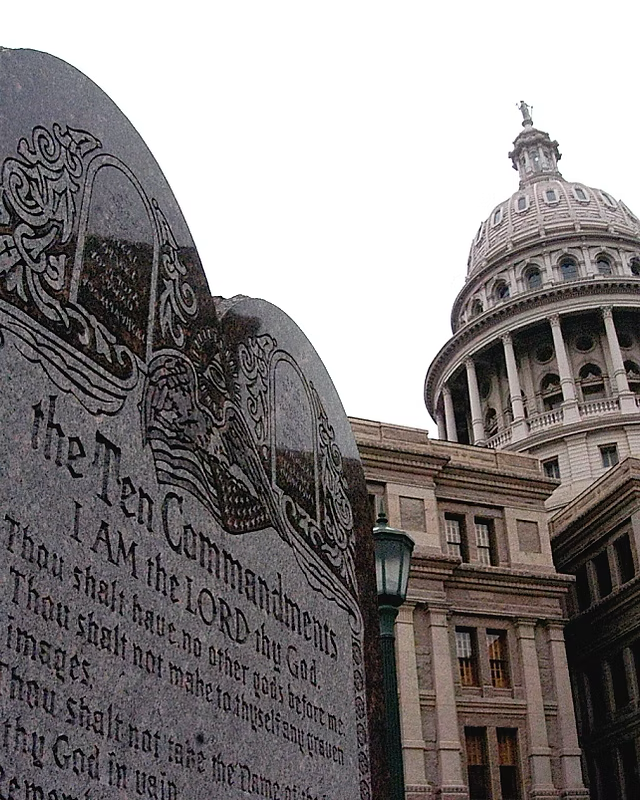
A slab of granite, six feet high, weighing in at just over three tonnes. Positioned between the Arkansas State Capitol and the Justice Building, in all honestly it looks like it could’ve always been there. For some, the text is relatively familiar; a version of the Ten Commandments, carved quite literally into stone, with a certainty that they have not been put there for discussion.
The legal story is a little more complicated however… In 2017, Arkansas authorised the monument through the Ten Commandments Monument Display Act, allowing a privately donated installation on Capitol grounds. It stood for less than 24 hours, before being mowed down by a man who’d destroyed the same statue outside Oaklahlma’s Capitol in 2014. The new monument (protected by concrete bollards this time) was reinstated in 2018, where it stands to this day.
This could’ve been the end of things, luckily (?!) for us though, it wasn’t. Because almost immediately, the presence of the monument raised a fairly obvious question: if this is allowed, what else is?
TST’s response was not subtle.
They proposed installing their own monument: a 7.5-foot bronze statue of Baphomet, equal parts occult iconography and deliberately confrontational design. At one point in 2018, they temporarily transported the statue to the Arkansas Capitol on a forklift as part of their ongoing protest. It did not stay, but that was never really the aim.
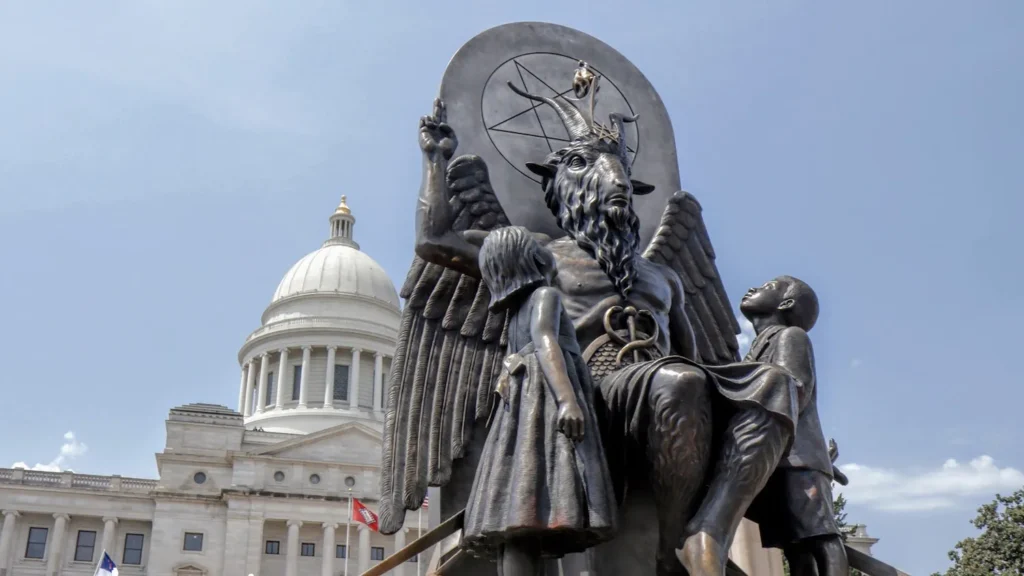
The point was to force a decision. As one rally organiser put it: “If you’re going to have one religious monument up then it should be open to others, and if you don’t agree with that then let’s just not have any at all.”
That was pretty much the entire legal argument, distilled into one sentence. Naturally, Arkansas declined the offer. Which, from a constitutional perspective, is where things begin to unravel.
Trying to make sense of this through a UK legal lens requires a bit of adjustment. The United States does not have an established church, but it has built an entire constitutional framework around making sure it doesn’t accidentally acquire one. The Establishment Clause of the First Amendment is the main tool for doing that, though exactly how it works depends very much on which case you are reading.
The traditional starting point is Lemon v. Kurtzman, with its requirement for a secular purpose and neutral effect. Later cases like County of Allegheny v. ACLU ask whether a reasonable observer would perceive endorsement, while more recent decisions, such as American Legion v. American Humanist Association, lean more heavily on history and tradition suggesting that longstanding religious displays might be permissible simply because they have become part of the landscape.
Arkansas really liked this idea.
The Ten Commandments, as the argument went, are part of the historical foundation of American law. Displaying them is simply educational, not devotional.
If something is genuinely about history, it tends to explain itself. It provides context, acknowledges alternatives, and situates itself within a broader narrative. You are not expected to simply accept it … you are invited to understand it. This monument did not do that.
It presents a religious text, on its own, without commentary. And as the court noted, the Ten Commandments are quite clearly “a sacred text in the Jewish and Christian faiths” (Cave v Jester, 2026). That is not controversial. It is just fact. The difficulty is what happens when that fact is placed, unqualified, on state property.
Because at that point, the display begins to look less like a historical reference and more like a statement of preference. A suggestion, intentional or not, that this particular set of beliefs holds a special place in the legal and moral order of the state.
There is precedent for allowing religious monuments in public spaces. In Van Orden v. Perry (2005), for example, a Ten Commandments display (which if I’m not mistaken, is exactly the same design as the Arkansas monument) was upheld because it was surrounded by other monuments, felt to be embedded in a broader historical context. It was one voice among many… This is where Arkansas missed the mark.
The moment the state opens the door to one religious display, it also has to decide what to do when another group comes knocking.
The Satanic Temple knocked loud and clear. They even brought their own statue along!
Their proposal was straightforward: if the Ten Commandments monument is permitted, then a statue of Baphomet should be allowed as well. Same space. Same process. Same rules. It was, legally speaking, a pretty clean argument. Either the state is operating a genuinely open forum, in which case all religious expressions should be treated equally, or it is not. And if it is not, then the claim of neutrality starts to fall apart.
Arkansas did not accept the proposal, with State senator Rapert stating that he
“respects everyone’s right to free speech under the First Amendment.” But, he continued, “It will be a very cold day in hell before an offensive statue will be forced upon us to be permanently erected on the grounds of the Arkansas State Capitol”.
This suggests that the space was never truly open. That the Ten Commandments were not there as part of a neutral historical display, but because they were considered acceptable in a way that other religious symbols were not. You could call it preference… The Constitution tends to call it something else.
The conclusion was, in many ways, inevitable. The court granted summary judgment in favour of the plaintiffs, including TST, and found that the monument violated the Establishment Clause (Cave v Jester, 2026). In this instance, the court did not rely on a single test. It did not need to. Whether approached through “Lemon”, endorsement, or even the more recent “history and tradition” framework, the result was the same. The monument lacked a clear secular purpose, functioned in a way that advanced a specific religious viewpoint, and was presented without the contextual safeguards that might have mitigated that effect.
TLDR; It crossed the line of neutrality, and will have to be removed, finding that “together with the other evidence in the record, conveys a message that the Christian religion is favored.
It would be easy to treat this case as a one-off, a slightly odd dispute involving a controversial monument and an even more controversial response. But the implications are broader than that, and reinforce a basic principle that states continue to test: you cannot selectively engage with religion in public space. If you allow it, you allow it fully. If you do not, you do not… there is no stable middle ground.
There’s definitely more to come on this! With The Church of Satan’s 80th anniversary fast approaching I’ll definitely be exploring it’s history, along with that of The Temple of Satan, in the very near future. Even after all of this, the same District Judge, Kristine Barker, who made the federal order to move the Ten Commandments Monument has blocked its actual enforcement, meaning that Arkansas officials still have 30 days reappeal the decision. While The Satanic Temple have, perhaps prematurely, declared this as their victory the case remains ongoing… As does the question of if we’ll ever see a permanent statue of Baphomet on state grounds. Regardless, it has certainly offered some interesting food for thought, and an interesting first look into Satan’s role in 21st century politics.
Keep Reading...