Some thoughts on the Festival’s most controversial iteration yet…
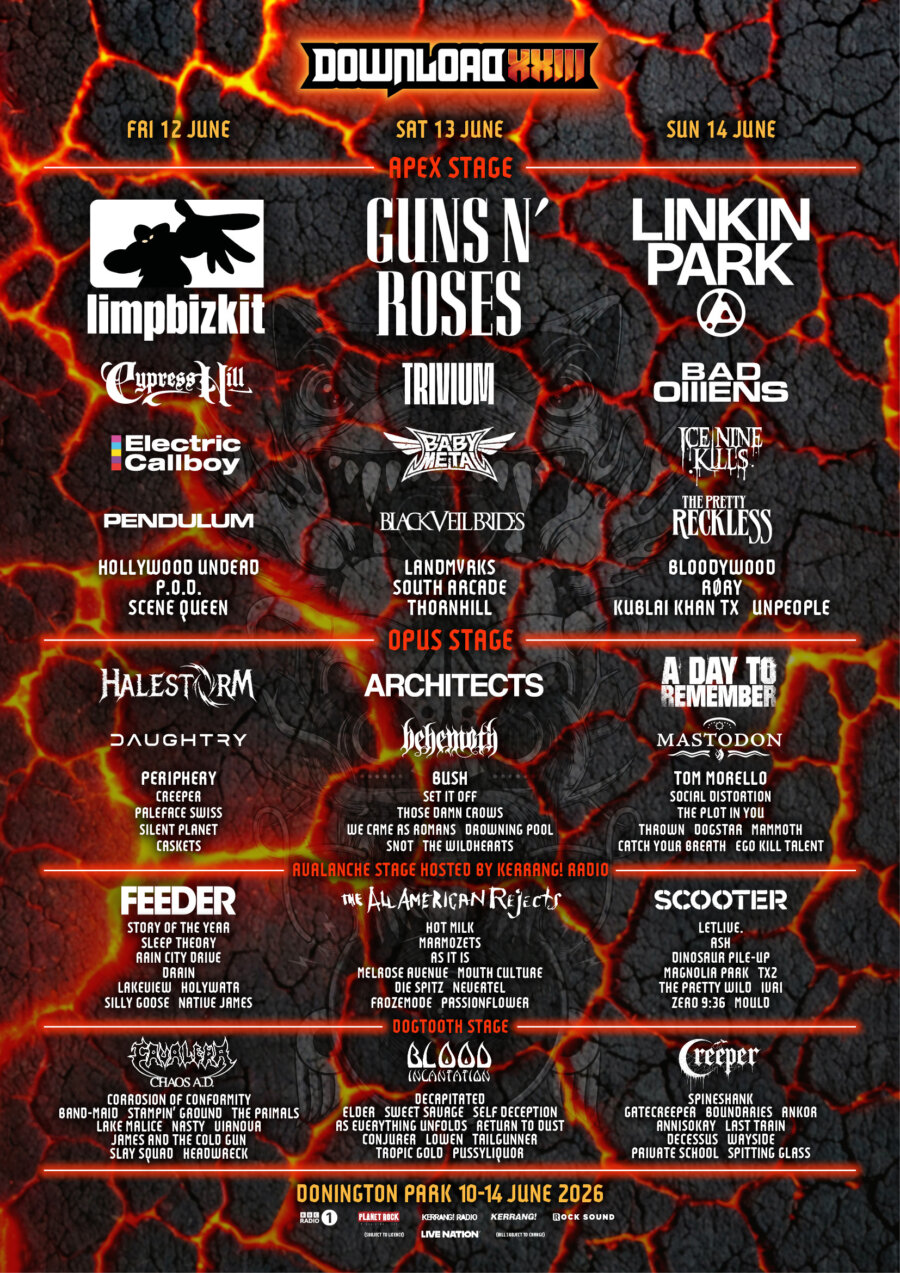
It goes without saying that Download 2026 has caused quite the stir, another year landing somewhere between pilgrimage, endurance test, and a very loud reminder that you are, in fact, not built for four days of sleeping on the ground and calling it “part of the festival”.
Despite being my fifth year returning to Donington, it’s still strange how quickly you fall into a routine once you’re there, the queues, the mud and dust, the “where are we trying to go?” conversations that happen every time you move… it all becomes part of the routine. You somehow manage to forgive how intense the Download experience can be once you get back home, probably something to do with the ever-evolving (and improving imo) line-ups and highlight worthy memories, which is exactly why it always feels so exciting to return.
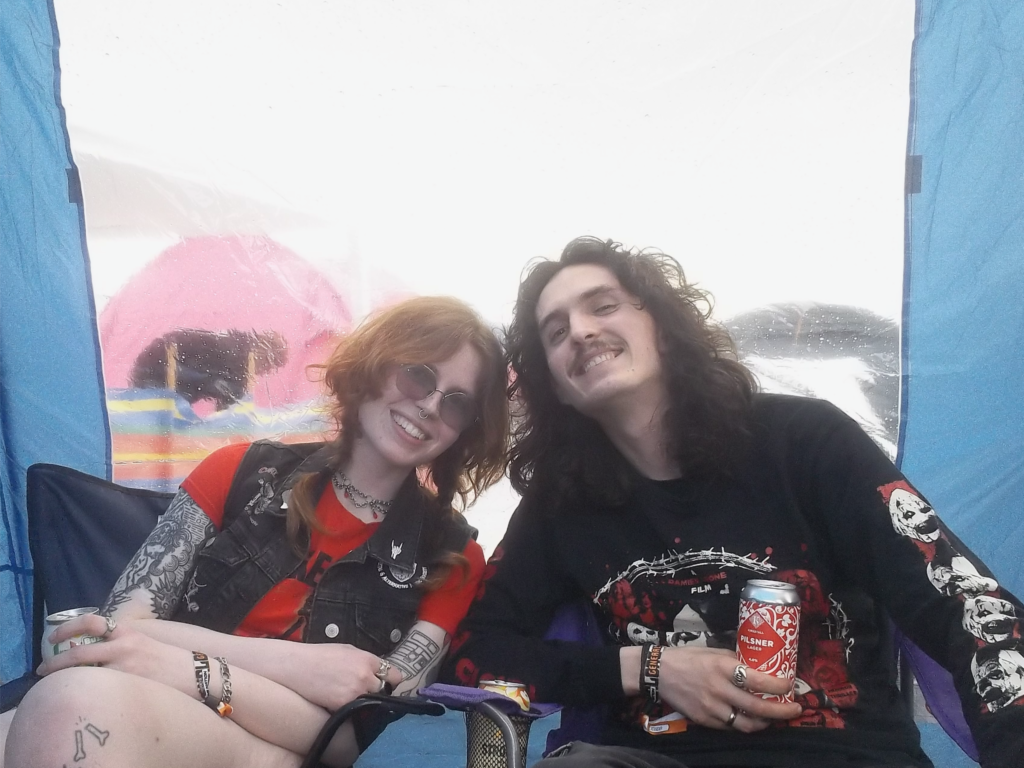
Artist wise the big one for me this year was Gatecreeper, an Arizona death metal band, who I’ve only being trying to see since 2021… Still, so worth the wait, with a set that was satisfyingly heavy and very little filler – it was no surprise they had some of the best pits of the weekend, although I did expect a bigger crowd for these guys if I’m being honest.
I was so sure Limp Bizkit would walk away with my personal headliner crown, but Linkin Park had other ideas. They surprised me in the best way. Emily Armstrong is an incredible vocalist and hearing just how much control she has live was probably the biggest takeaway from the whole set. I don’t think anyone could’ve left questioning whether she belonged on that stage.
Babymetal and Ice Nine Kills were two bands I’d already seen at Download before, so I had a pretty good idea what I was getting… and they absolutely delivered. Neither set reinvented the wheel, but both reminded me why I keep going back to see them. Sometimes it’s nice to have a couple of bands on the lineup that you know are going to put on a consistently great show. I did spend most of Friday and Saturday convincing myself we’d get an Electric Callboy x Babymetal crossover. Both bands were on site, they’ve already collaborated… the stars were aligned. Apparently not. A gal can dream.
Speaking of Electric Callboy, they were quite literally electric as always. This was my third time seeing them and they’re yet to let me down. It probably helped that the weather had finally sorted itself out too; jumping around to Hypa Hypa in the sun with a group of mates felt like the moment Download 2026 really got started for me.
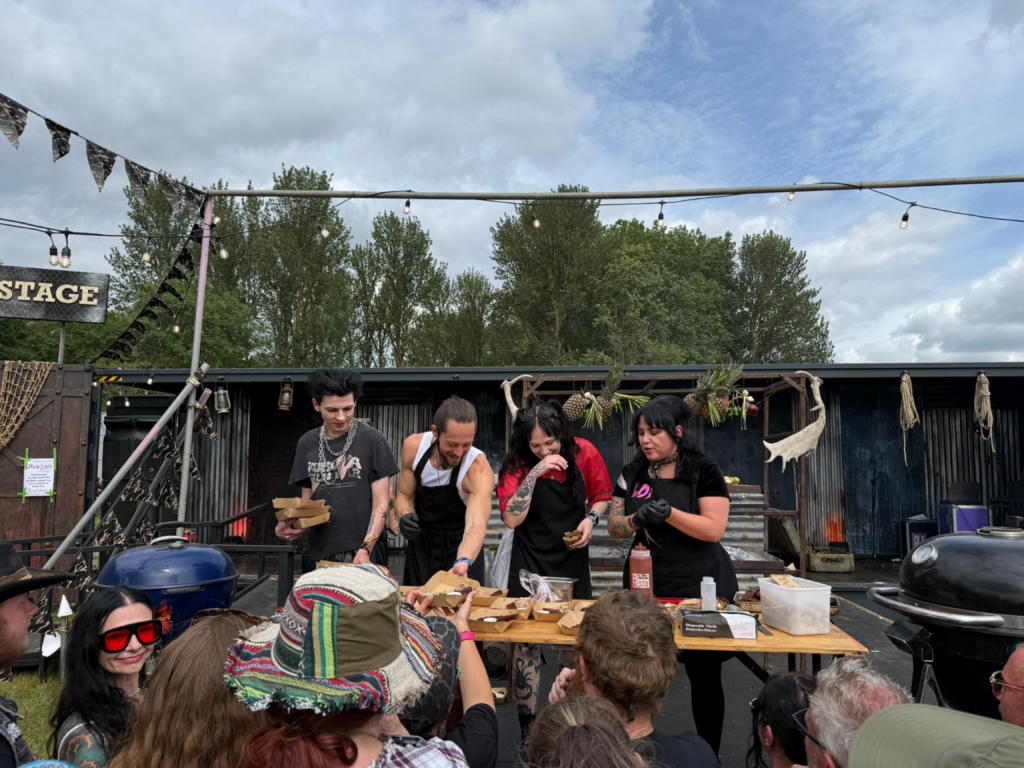
One of my favourite additions this year was the Hellfire Stage. It was nice having somewhere to head between bands that wasn’t just another food queue or patch of grass. Tom was absolutely in his element watching the cooking demos, but even as a veggie I found myself sticking around for far longer than I expected. I actually came away having learnt a fair bit from Lianna Davies from LD’s Kitchen too… definitely one of those “I’ll just watch for five minutes” situations that somehow turned into an hour.
The arena rides also made a welcome return. There’s something wonderfully bonkers about being able to watch a death metal band while people are being launched into the sky a few hundred metres away. It’s such a bizarre combination that only really makes sense at Download.
That said… maybe turn the music down a bit?
There were a few occasions where the rides seemed determined to compete with the stages, and I don’t think anyone needed to hear EDM remixes at the same volume as the headline acts. They’re a fun addition; not sure they need to announce themselves quite so enthusiastically though.
I also think Download still struggles with somewhere to simply exist when you’re not watching a band. Seating always seems to be in short supply, and after a couple of days your standards drop dramatically. You’re no longer looking for somewhere comfortable, you’re looking for somewhere (relatively) clean that isn’t already occupied by six other exhausted people who had the same idea.
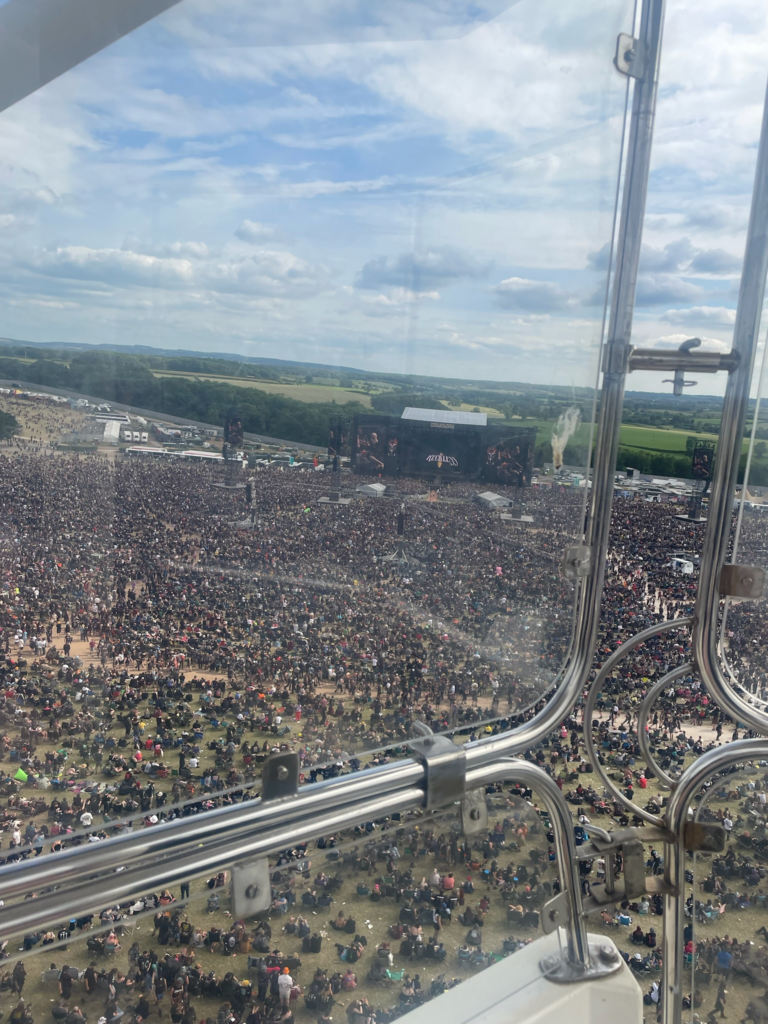
The overcrowding debate was impossible to ignore, too. Whether it was genuinely worse than previous years or whether certain parts of the site simply weren’t coping as well is difficult to say from one person’s perspective, but there were definitely moments where moving through the arena became slower than it probably should have been. It never ruined the weekend for me, but it was noticeable enough that I wasn’t surprised to see it become one of the biggest talking points online afterwards.
What interested me more, though, was how those conversations gradually merged into a much bigger one.
Has Download started to feel… corporate?
I’m not convinced it’s a simple yes or no, but I do think this was the first year where I found myself noticing the machinery behind the festival a little more than I’d have liked.
The megastore queue was legitimately eyewatering, but it’s almost become part of the Download experience at this point. What stood out more to me were the little details. Replacing the Download totems on the main stage with giant LED screens felt like such a small change, yet it subtly altered the atmosphere. I kept expecting them to be used to celebrate the festival itself between sets… archive posters, redesigned totems, maybe even an episode of Deathklok!?
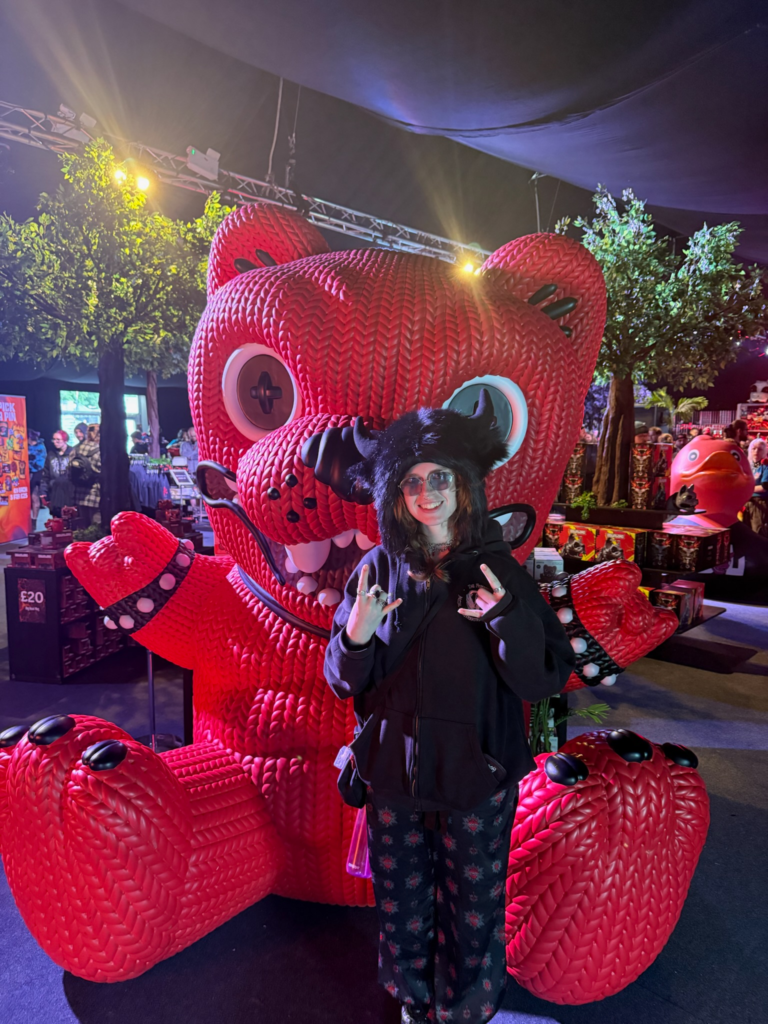
Instead, they became another advertising space. It’s hardly the end of the world. Festivals cost money to run, sponsors keep the lights on, and nobody should pretend otherwise. But moments like that do make you slightly more aware that beneath all the patched jackets, inflatable dinosaurs and circle pits sits an enormous commercial operation.
It was definitely those conversations that ended up feeling the loudest… and the ones I was most interested in unpicking once I got home. If Download 2026 has taught us anything over the last two decades, it’s that putting 80,000-plus metalheads in a field is less a cultural event and more a surprisingly complicated legal exercise.
Behind every circle pit, beer tent and headline set sits a mountain of legislation designed to make sure none of this goes catastrophically wrong. And no, festivals can’t just decide to sell more tickets when demand is high… capacity limits are one of the most heavily scrutinised parts of UK event licensing, and they exist for very good reason.
The backbone of all of this is the Licensing Act 2003. Any event selling alcohol, hosting live music, or operating late-night refreshment has to hold a premises licence, and under that licence local authorities are legally required to uphold four objectives: preventing crime and disorder, ensuring public safety, preventing public nuisance, and protecting children from harm. It’s the “public safety” bit that sneakily underpins everything you experience on site.
Capacity comes from crowd modelling, evacuation planning, infrastructure limits, medical provision, transport access… and a lot of very complicated maths about what happens when thousands of people try to move at once. This is why “oversold” argument doesn’t really hold up. The licensed capacity isn’t flexible – it’s part of the safety case. Go beyond it and you’re not dealing with queues… you’re dealing with a breached licence.
On top of that, there’s the Health and Safety at Work etc. Act 1974, which covers everything from stage construction to crowd management to the general expectation that nobody ends up in avoidable danger just because it’s a festival. The Regulatory Reform (Fire Safety) Order 2005 steps in too, which sounds a bit abstract until you remember you’re basically sleeping in a temporary city of tents with gas stoves, generators, and drunk people with cigarettes everywhere.
The Purple Guide sits behind a lot of how festivals like Download actually run… even if it isn’t technically law. It lays out how events are supposed to run in practice: crowd densities, barriers, stewarding, entry and exit routes, emergency planning, communication. Ignore it and you’d struggle to convince a Safety Advisory Group (SAG – they’re the big guns) you know what you’re doing.
That’s the final layer in all of this: Safety Advisory Groups – police, local councils, fire, ambulance services – all going through the entire event plan before gates open and stress-testing it from every angle, until there’s enough confidence that it works in reality and not just on paper.
In all honesty I think this is what I actually find most interesting about festivals like Download. From the outside it can look like chaos, but it only works because it’s been designed not to be.
This is why, strangely, all the talk about overcrowding and scale doesn’t really sit as a simple opinion. It starts to feel more structural than that… less “did it feel busy?” and more “how is this even allowed to operate at this size?” And the answer, slightly unglamorous as it is, is paperwork. A lot of it.
Keep Reading...