An analysis of goregrind’s evolution from death metal and grindcore, examining how the genre uses sound, disgust, and horror aesthetics to challenge moral boundaries.


There’s no polite way to introduce goregrind. It doesn’t ease you in or gesture toward accessibility; it kicks down your front door, shits on your carpet, then rummages through the fridge and eats the sweet treat you were saving for later. Not cool. For most listeners, myself included, that first encounter feels less like hearing music and more like being assaulted by it. Vocals collapse into texture, guitars blur into density, and rhythm registers as impact rather than structure. There is sound, but it resists immediate interpretation, leaving the listener to decide just what to do with it.

And yet, none of this is particularly unusual when placed alongside horror cinema. Splatter films have long operated on similar terms, pushing visual excess beyond plausibility and foregrounding artifice rather than realism. Bodies rupture, blood behaves in impossible ways, and practical effects strain under the weight of their own exaggeration; leaving viewers wondering:

“If We Cannot Rely on Our Own Bodies Then on What Can We Rely?” (Cruz, 2012 , p. 167)

Crucially, these elements are not typically read as moral statements. As Carroll (1990), noted Horror Philosopher (cool job title alert), argues:

“The objects of art-horror are essentially categorical violations and, as a matter of fact, categorical violations will quite regularly be the sorts of things that will command attention” (p. 191).

Horror relies on the coexistence of disgust and fascination, with exaggerated violence functioning as spectacle rather than endorsement. This is not a new discovery, and there is much research into the relationship between horror viewership and moral sanction (Martin, 2019; Pascale, 2016; Woodcock, 2023). Extreme metal on the other hand, is rarely granted the same assumption…

Goregrind, in particular, is often treated less like an aesthetic form and more like something to be justified, as though its extremity requires explanation in a way that cinematic violence does not. This essay takes a different approach. Rather than asking why goregrind is so excessive, it asks why that excess is interpreted differently across media, and what that difference reveals about how violence is framed, consumed, and understood.

Because once you stop taking it literally, goregrind becomes much easier to read.


WTF Is Goregrind?!

Before going any further, it’s probably worth pausing to clarify terms. Like most metal subgenres, goregrind is often discussed as though its meaning is self-evident. And so, while many readers will have a rough sense of what the genre sounds like — fast, noisy, obscene — that familiarity often masks a more fundamental misunderstanding about how it actually operates. At its most basic level, goregrind is a form of extreme metal defined by sonic density, brevity, and a sustained focus on the body as material rather than subject. Songs are typically short, percussion is driven by blastbeats, guitars prioritise distortion over clarity, and vocals are frequently processed to the point where they cease to function as language in any conventional sense. What remains is not absence, but transformation; meaning shifts from words to texture.

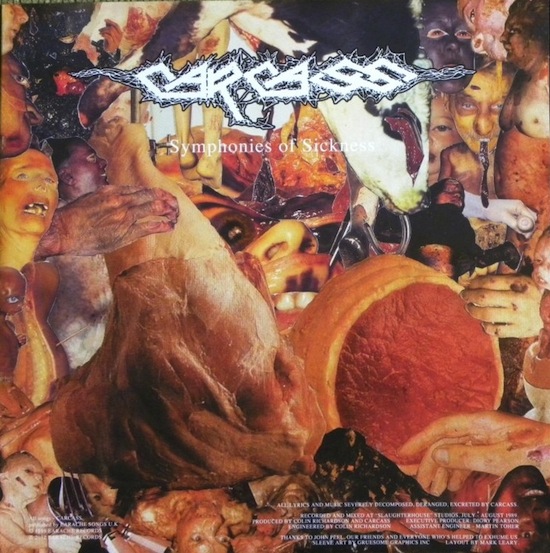
Symphonies of Sickness, Carcass (1989)
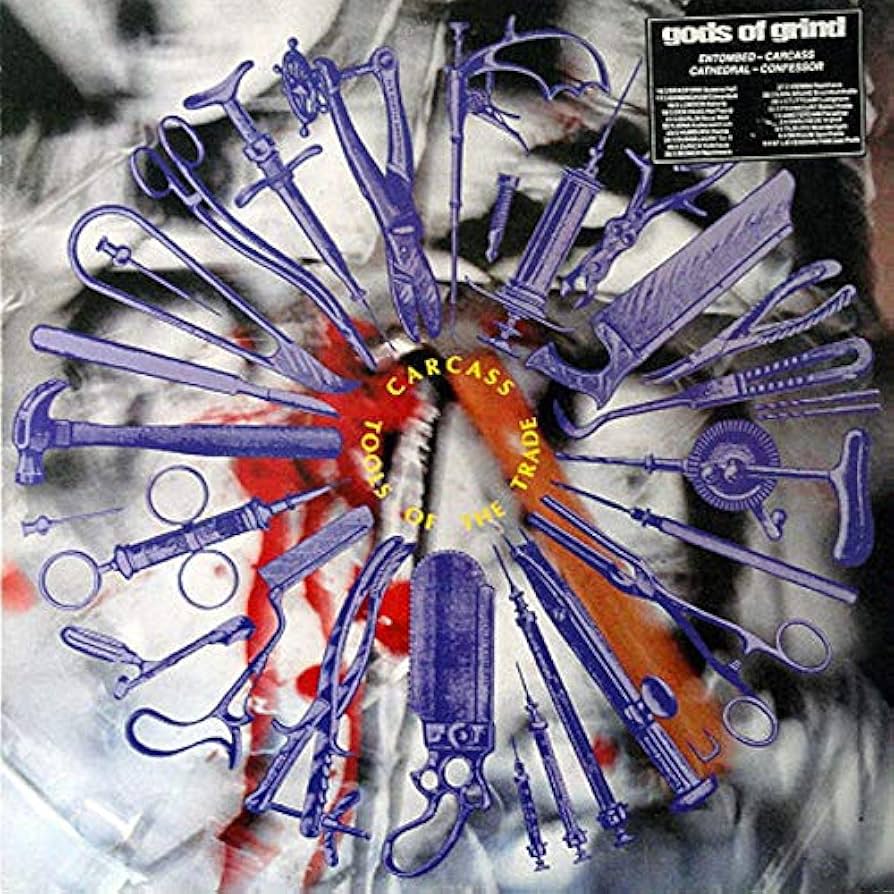
Tools of the Trade, Carcass (1992)

Bands such as Carcass establish this approach early on. Their late-1980s and early 90s releases replace conventional lyricism with medical terminology and fragmented anatomical description, while their artwork draws directly from pathological imagery. As Tulonen (2018) argues, this use of discursive transgression functions less as simple provocation and more as a means of generating symbolic power within the extreme metal scene, marking both aesthetic commitment and subcultural literacy (pp. 80-82). What matters here is not simply the presence of gore, but how it is organised. There are no stories to follow, no characters to attach to, and no clear narrative framing through which violence can be interpreted.

Later bands such as Regurgitate, Haemorrhage, and Last Days of Humanity refine this approach rather than depart from it. Intelligibility is reduced further, and the voice in particular is pushed away from recognisable human expression. Structure still exists, but it is submerged beneath layers of distortion and compression, requiring a different mode of listening to perceive it.

This is where goregrind is most often misread. Outside the subculture, its imagery is frequently taken at face value, interpreted as literal rather than aesthetic. Within it, however, that same imagery functions as a kind of shorthand — a way of signalling extremity, familiarity, and intent. As Radovanović notes, extreme metal often deploys exaggerated imagery not to communicate belief, but to test the limits of representation itself (Wabnegger & Schienle, 2025, p. 8). Understanding that distinction is what allows the genre to make sense.


From Death Metal to Goregrind: How Extremity Found the Body

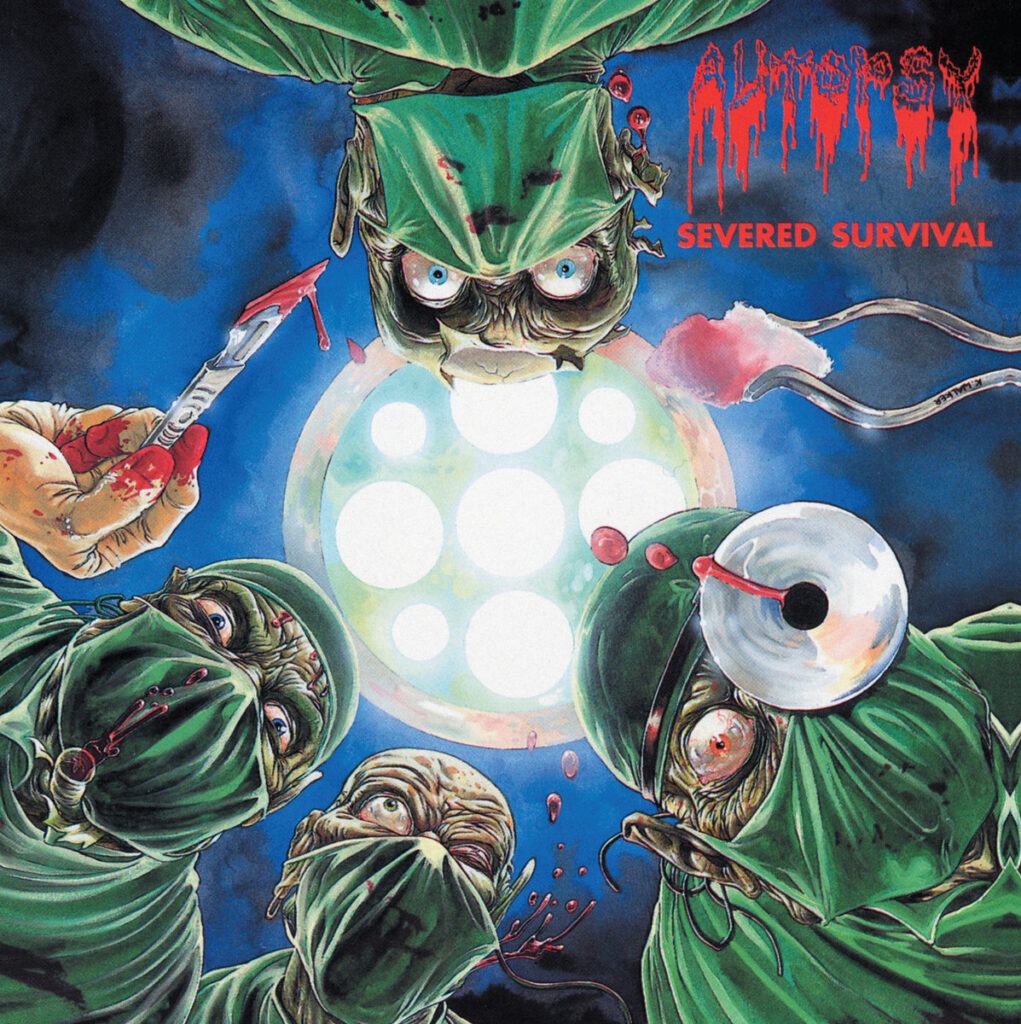
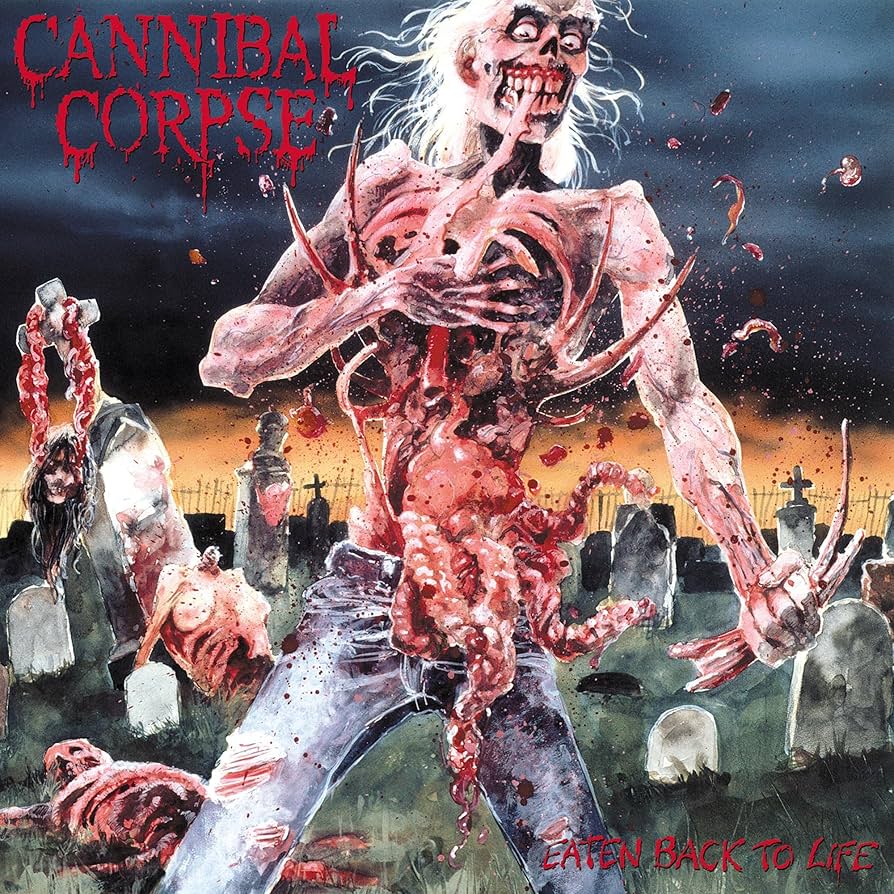
Goregrind did not appear out of nowhere however! It developed through the convergence of two already extreme forms: death metal’s fixation on the body, and grindcore’s fixation on compression, speed, and sonic force. What goregrind does is not invent these tendencies, but force them into alignment in a way that fundamentally alters how they function. As leading metal scholar Kahn-Harris notes, extreme metal genres often evolve through internal differentiation, pushing existing boundaries in order to establish new forms of extremity (Kahn-Harris, 2007, p. 6).

Servered Survival, Autopsy (1989)
Eaten Back To Life, Cannibal Corpse (1990)

Goregrind emerges at the point where these trajectories intersect. From death metal, it takes the body as central aesthetic material, but strips away narrative framing. From grindcore, it takes compression and sonic density, but redirects them away from overt political critique. What results is a form in which representation begins to collapse entirely, replaced by accumulation and excess.

Early Carcass recordings make this shift particularly visible. Medical terminology replaces narrative language, while sonic density overwhelms clarity. The body is no longer described in ways that can be followed or reconstructed; it is fragmented into parts that resist coherence. Later bands intensify this approach, pushing both sound and structure further toward abstraction. At this point, the listener is no longer observing violence… They are immersed in it.

This marks a shift from representation to sensation. Death metal shows the body, grindcore destabilises how it is communicated, and goregrind removes the remaining distance between material and audience. What remains is not narrative violence, but sensory excess — a move that places goregrind in direct alignment with splatter cinema at the level of method rather than content.


When The Body Becomes Sound

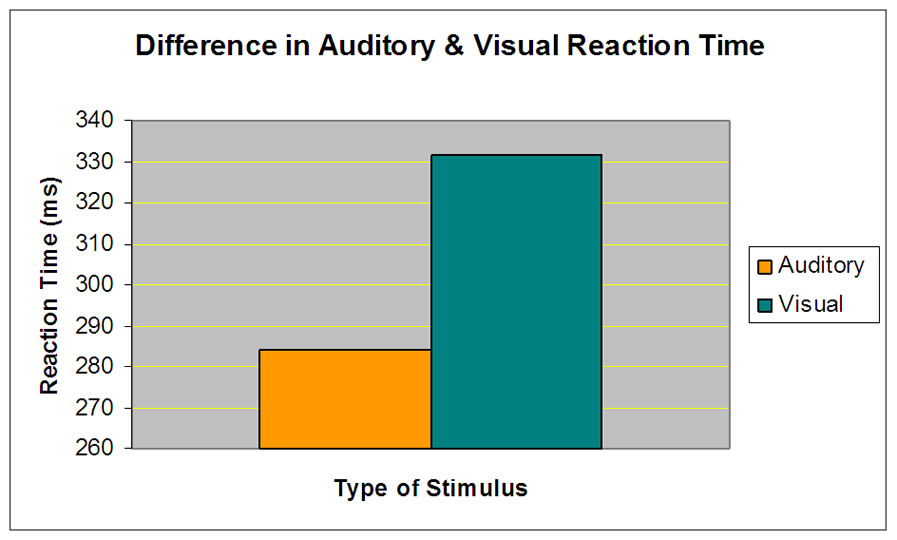
If goregrind’s history explains how it was formed, its sound explains why it unsettles. Sound behaves differently to image. It occupies space, moves through the body, and resists containment in ways that visual media does not. You can look away from an image; you cannot disengage from sound as easily, with research showing that auditory reaction time is faster than visual reaction time (Shelton & Kumar, 2010, p. 31). Goregrind exploits this directly, treating sound as something almost physical rather than purely representational.

Shelton & Kumar, 2010, p. 31

Vocals are processed until they resemble internal bodily noise rather than speech, collapsing the distinction between voice and texture. Guitars prioritise density over articulation, while percussion becomes impact rather than rhythm in any conventional sense. The result is not a depiction of violence, but something closer to its sonic equivalent, where the body is no longer shown but implied through sensation.

Kristeva’s concept of abjection is useful here. She defines it as that which “disturbs identity, system, order,” occupying a space where boundaries begin to break down (Kristeva & Lechte, 1982, p. 3). Goregrind’s sound operates precisely in this space, eroding distinctions between human and non-human, structure and noise, meaning and sensation. The listener is not invited to interpret in a conventional sense, but to experience a form of organised excess that resists stable categorisation.

In horror films, the body is shown breaking apart. In goregrind, that breakdown is translated into sound.

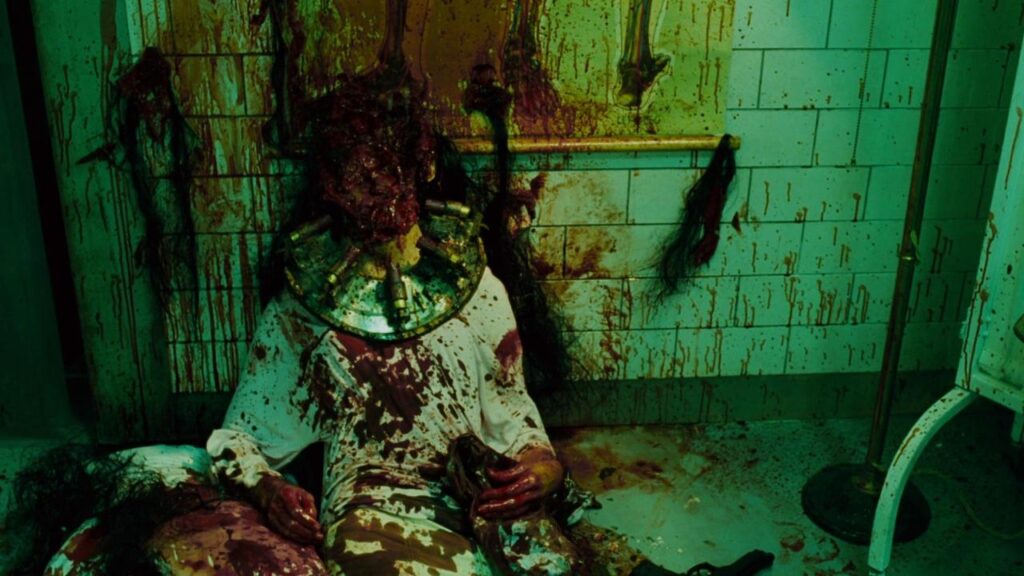
Cannibal Holocaust (1980)
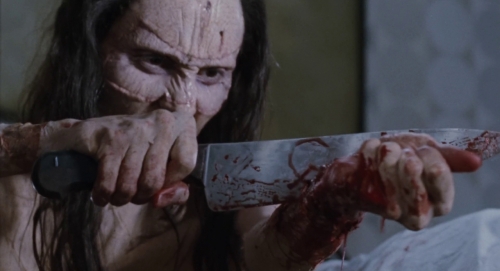
Saw IV (2007)
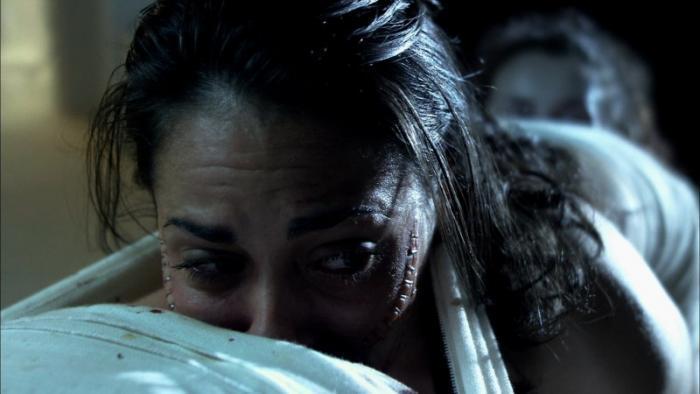
Martyrs (2008)
The Human Centipede (2009)

As Steinbach (2020) argues, horror often functions through a balance between immersion and abstraction, where the audience is physically engaged while meaning remains unstable (pp. 28-31). Goregrind intensifies this balance, pushing immersion to the foreground while allowing abstraction to dominate interpretation. The result is a form of sonic horror that operates not through narrative, but through sustained sensory pressure.


Disgust, Pleasure, and Learning to Listen

None of this explains why people actually enjoy goregrind though, and this is where the discussion becomes more interesting. Disgust, on its own, is not enough to sustain engagement. What matters is how that disgust is structured, and how listeners learn to navigate it over time.

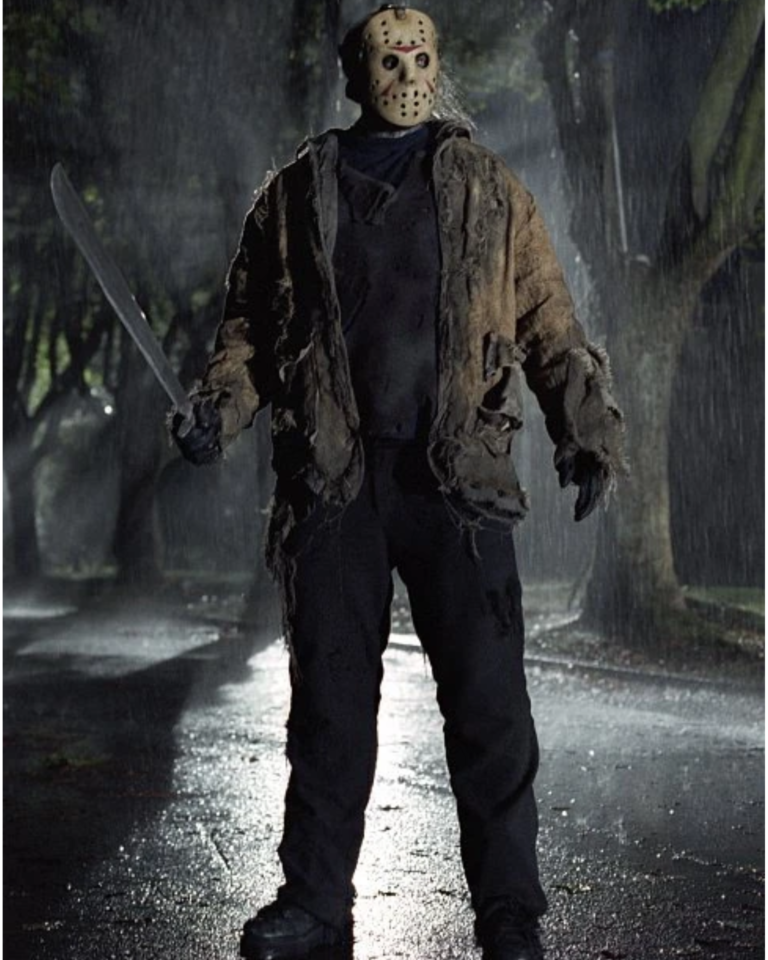
Horror theory provides a useful framework here. Carroll argues that disgust and pleasure are not opposites, but interdependent responses that rely on the framing of the object as aesthetic rather than literal (Carroll, 1990, pp. 17–19). Goregrind operates on the same principle, but without the narrative scaffolding that film provides. Without the visual aid of masked killers or gnarly creature features, instead, it requires listeners to develop a different kind of competence.

Friday 13th (1980)
Saw (2004)
Hostel (2005)
Teriffier (20216)

Appreciation of the genre is acquired rather than immediate. Initial exposure often registers as noise or chaos, but repeated listening reveals patterns: shifts in tempo, variations in vocal technique, differences in production. What once felt overwhelming becomes legible, not because it has changed, but because the listener has. As Smialek notes, extreme vocal styles in metal are often understood not as conveyors of semantic meaning, but as expressive timbres that require genre-specific listening practices (Smialek, 2015, pp. 92–96).

This is not desensitisation, it is a form of aesthetic competence.

Within the scene, this competence functions as subcultural knowledge. Thornton’s concept of subcultural capital helps explain how value is produced through familiarity and distinction, with meaning emerging from the ability to interpret cultural codes correctly (1995, pp. 11-13). Goregrind’s extremity therefore operates not just as aesthetic choice, but as a filtering mechanism, separating those who can read it from those who cannot.

Disgust, in this context, becomes part of the mechanism rather than an obstacle to it.


So Why Does Horror Get A Free Pass?

At this point, the comparison with horror cinema becomes unavoidable. If splatter films are accepted as aesthetic forms, why is goregrind still treated as suspect? Why does one medium get to present extreme violence without explanation, while the other is expected to justify itself? Andrew O’Neill’s observation about Slayer captures this tension directly:

“Horror films do not feel the need to flag up that people being killed is a bad thing. As an audience we are expected to have some sense and make that decision ourselves… Slayer work on the assumption that their audience are not genocide-supporting psychopaths…” (2018, p. 124)

Okay, yes, there’s an obvious irony to this point… but it doesn’t take away from the fact that extreme metal is rarely afforded the same assumption, particularly when it operates at the level of sound rather than image. The difference lies in perception. Film is understood as representation — framed, contained, and clearly fictional. Music, particularly extreme music, is often treated as more immediate and embodied, partly because of how it is experienced physically. This distinction shapes how violence is interpreted, with sonic forms more likely to be read as expressive or reflective of intent. As Kahn-Harris (2007) argues, extreme metal is frequently subject to moral scrutiny not simply because of its content, but because of its position outside dominant cultural norms and its resistance to easy interpretation (pp. 6-7). Goregrind intensifies this resistance by removing narrative framing almost entirely, leaving listeners without the usual tools for contextualising what they are hearing.

It is also important to situate horror’s aesthetic development within broader structures of regulation that have historically constrained its circulation and reception. In the UK context, the Video Recordings Act 1984 and the surrounding “video nasties” moral panic subjected horror cinema to formal classification, censorship, and in some cases outright restriction. As a result, horror did not operate with unrestricted aesthetic freedom; its formal and thematic experimentation was always already entangled with institutional oversight and public anxiety. By contrast, popular music—despite periodic moral panics around genres such as heavy metal—has not been governed by equivalent systems of legal classification or distribution control. While it has been culturally policed, it has not been structurally regulated in the same way as home video horror. This uneven regulatory landscape further complicates assumptions about genre freedom, revealing horror as a medium historically shaped by external constraint, whereas music has been able to develop its aesthetic strategies with comparatively fewer formal restrictions.

The issue therefore is not the content itself; rather it is the proximity to the listener that causes the most discontent.

To Conclude

Goregrind is often dismissed as excessive, incoherent, or deliberately offensive. These readings mistake intensity for failure. What the genre actually does is reorganise how meaning is produced, shifting attention away from narrative and toward sensation, texture, and structure.

By translating visual horror into sound, goregrind removes the distance that usually separates audience from material. It replaces clarity with density and representation with experience, creating an aesthetic that operates through immersion rather than explanation. Disgust, in this context, is not something to be resolved or overcome, but something to be worked through.

As Cummings-Coughlin (2024) suggests in relation to horror more broadly, extreme representations of violence can function as “safe” engagements with discomfort precisely because they are exaggerated and aestheticised (pp. 329-331). Goregrind operates in much the same way, relying on excess and abstraction to produce affect without requiring literal interpretation. Disgust, here, is not a mistake… It is the point.

And once that is understood, goregrind no longer reads as excess gone wrong, but as a precise, controlled, and deliberately uncompromising aesthetic practice; one that operates exactly as intended.


References:

Carroll, N. (1990). The Philosophy of Horror: Or, Paradoxes of the Heart (1st ed.). Routledge. 

Cummings-Coughlin, C. R. (2024). The Summit of Safe Horror. European Journal of Analytic Philosophy, 20(2), 323-343. https://doi.org/10.31820/ejap.20.2.4

Cruz, R. A. L. (2012). Mutations and Metamorphoses: Body Horror is Biological Horror. Journal of Popular Film and Television, 40(4), 160-168. https://doi.org/10.1080/01956051.2012.654521

Kahn-Harris, K. (2007). Extreme metal: Music and culture on the edge. Berg.

Kristeva, J., & Lechte, J. (1982). Approaching Abjection. Oxford Literary Review, 5(1/2), 125-149. http://www.jstor.org/stable/43973647

Martin, G. N. (2019). (Why) Do You Like Scary Movies? A Review of the Empirical Research on Psychological Responses to Horror Films. Frontiers in Psychology, 10(2298). https://doi.org/10.3389/fpsyg.2019.02298

O’Neill, A. (2017). A History Of Heavy Metal. Headline.

Pascale, M. A. (2016). What monsters may they be: the moral status of macabre fascination and the paradox of horror. Legacy Theses & Dissertations (2009 – 2024), 1695. https://doi.org/10.54014/2S49-DTAN

Shelton, J., & Kumar, G. P. (2010). Comparison between Auditory and Visual Simple Reaction Times. Neuroscience and Medicine, 1(1), 30-32. https://doi.org/10.4236/nm.2010.11004

Smialek, E. (2016). Genre and expression in extreme metal music, ca. 1990-2015. [Doctoral thesis]. McGill University. https://escholarship.mcgill.ca/concern/theses/qv33s018k

Steinbach, A.M. (2020). Horror’s Aesthetic Exchange: Immersion, Abstraction and Annihilation. USF Tampa Graduate Theses and Dissertations. https://digitalcommons.usf.edu/etd/8301

Thornton, S. (1995). Club Cultures: Music, Media and Subcultural Capital. Polity Press.

Tulonen, U. (2018). Extreme metal and the grotesque: Utilization of pathological imagery in the early album covers of Carcass (1987-1989). [Master’s thesis]. University of Jyväskylä. https://urn.fi/URN:NBN:fi:jyu-201808153841

Wabnegger, A., & Schienle, A. (2025). From decay to delight: Disgust processing among extreme metal enthusiasts. Personality and Individual Differences, 245. https://doi.org/10.1016/j.paid.2025.113281

Woodcock, S. (2023). It’s A Fine Line Between Sadism And Horror. Journal of Ethics and Social Philosophy, 25(1). https://doi.org/10.26556/jesp.v25i1.2409

 

Keep Reading...

All Hail the Goat

Goats are one of the most recognisable symbols in Satanic imagery — from medieval depictions of the...

Satanic Temple Declares Arkansas Victory

How The Satanic Temple’s Baphomet challenge exposed constitutional limits on religious monuments in...

The Lamb by Lucy Rose

The Lamb was incredibly easy to fall into. I finished it much quicker than I expected, largely...